
Micro-Influencer Campaign ROI Calculator Guide & Measurement Framework
A practical measurement framework for calculating and optimising the ROI of micro-influencer campaigns. Includes benchmark data by industry, calculation tables, attribution methodology, and worked examples across different campaign and compensation models.
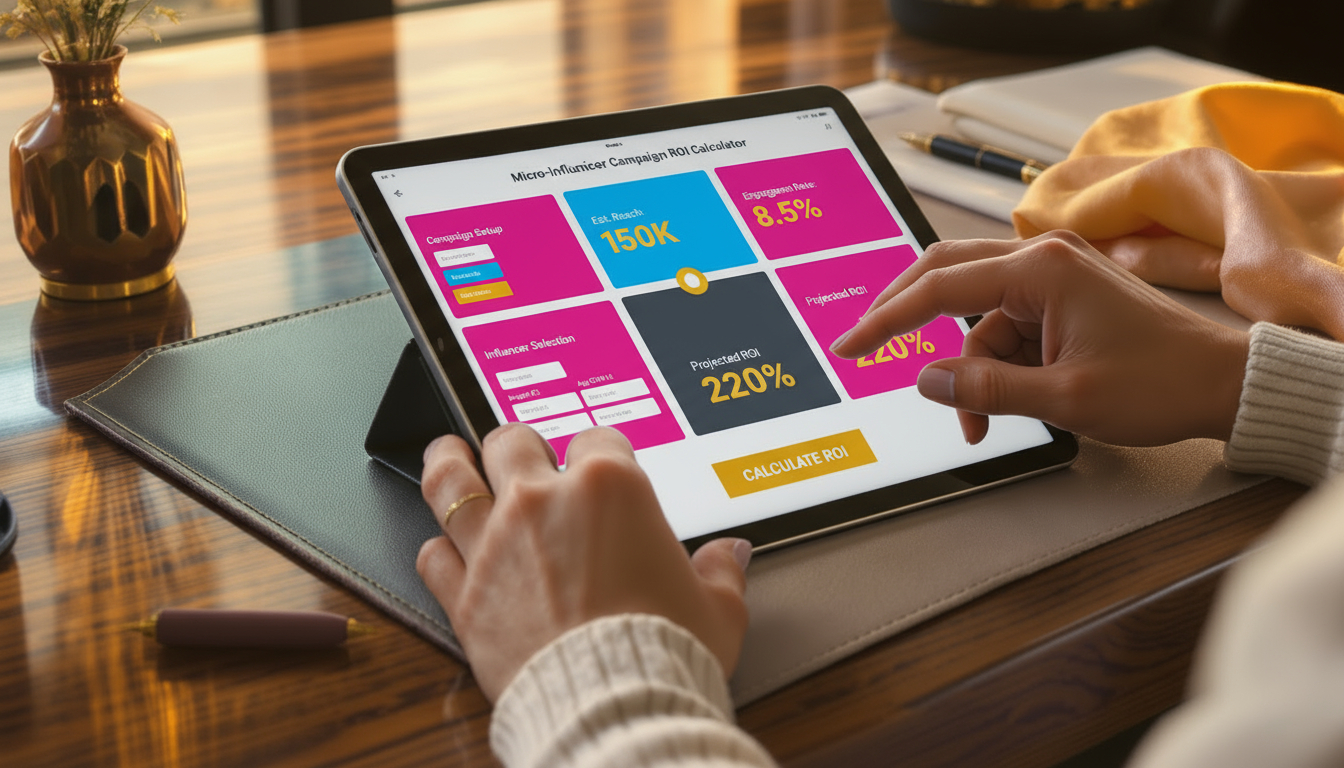
Micro-Influencer Campaign ROI Calculator: Your Complete Guide to Measuring Marketing Returns
In today's digital marketing landscape, micro-influencers—content creators with 10,000 to 100,000 followers—have become powerful assets for brands seeking authentic connections with engaged audiences. However, measuring the true return on investment from these campaigns remains challenging for many marketers. This comprehensive guide will equip you with the essential knowledge to calculate, track, and optimize your micro-influencer campaign ROI.
Understanding the Core ROI Formula
The basic ROI calculation follows a simple formula: ROI = (Revenue Generated - Campaign Cost) / Campaign Cost × 100. However, micro-influencer campaigns generate value beyond immediate sales. To capture the complete picture, you must account for engagement value, brand awareness metrics, and content creation savings.
Advanced engagement metrics matter significantly. For micro-influencers, engagement rates between 3-10% are considered excellent, substantially outperforming larger influencers who typically see 1-3%. Focus on save rates (above 2% indicates high-value content), story completion rates (above 70% shows compelling content), and link click-through rates (micro-influencers typically achieve 1.5-3%).
ROI calculations should extend beyond immediate campaign periods. Track conversions for at least 30 days post-campaign, as many consumers need multiple touchpoints before purchasing. Research shows influencer-driven customers often have 25-40% higher retention rates due to trust-based acquisition.
Building Your Campaign Budget
Strategic budget allocation determines campaign success. Distribute your budget across these categories: influencer compensation (50-60%), content production support (10-15%), paid amplification (15-20%), tools and technology (10-15%), and a contingency buffer (5-10%).
For micro-influencers, expect to pay $100-$500 per post depending on follower count, engagement rate, and content complexity. When forecasting returns, micro-influencer campaigns typically convert at 2-5% of engaged viewers, with an average engagement rate of 6% producing approximately 1,500 interactions per post for an influencer with 25,000 followers.
Industry-Specific Engagement Benchmarks
Context is everything when evaluating performance. Based on analysis of over 100,000 micro-influencer posts, here are median engagement rates by industry:
- Beauty and Cosmetics: 7.2%
- Home and Interior Design: 6.8%
- Sustainability and Eco-Living: 6.4%
- Health and Fitness: 6.1%
- Food and Beverage: 5.9%
- Parenting and Family: 5.7%
- Travel and Hospitality: 5.3%
- Fashion and Apparel: 4.8%
- Technology and Gadgets: 3.2%
- Finance and Business: 2.9%
Use these benchmarks strategically by requiring potential partners to exceed category benchmarks by at least 20%. An influencer consistently delivering engagement 50% above their industry median deserves premium compensation or longer partnerships.
Calculating Cost Per Acquisition
Cost per acquisition reveals true campaign efficiency. The formula is simple: CPA = Total Campaign Cost / Number of Customers Acquired. However, proper calculation requires comprehensive cost tracking including direct influencer payments, product costs, platform fees, internal labor, creative development, and paid amplification.
Implement multi-touch attribution through unique promo codes, custom landing pages, UTM parameters, and pixel-based retargeting. Determine your attribution window based on product category: 7-14 days for impulse purchases under $50, 30 days for considered purchases $50-$200, and 60-90 days for high-ticket items over $200.
Most importantly, factor in customer lifetime value. Influencer-acquired customers typically have 20-35% higher retention rates. If your standard customer LTV is $300 but influencer-acquired customers average $375 LTV, you can justify a proportionally higher CPA while maintaining profitability.
Essential Tracking Tools
Professional-grade tools automate data collection and provide actionable insights. AspireIQ manages everything from influencer discovery to payment and performance analytics, starting at $1,000 monthly. Upfluence integrates with e-commerce platforms to track direct sales attribution, beginning at $795 monthly. HypeAuditor specializes in fraud detection and authentic audience verification.
For implementation, integrate tools with your existing marketing stack, set up custom UTM parameters for each influencer, establish baseline metrics before campaigns launch, and create automated reports that aggregate performance across all active campaigns.
Instagram-Specific ROI Measurement
Instagram accounts for approximately 68% of all influencer campaign spending. Track platform-specific metrics including story sticker interactions, reel performance (often reaching 2-3x follower count), shopping tag performance, profile visit rates (above 2% indicates strong interest), and follower growth attribution.
Build your Instagram ROI calculator with input variables including follower count, average engagement rate, number of posts/stories, campaign cost, average order value, and expected conversion rate. Calculate projected impressions as followers × posts × 1.3 (accounting for reach beyond followers), then multiply by engagement rate and conversion rates to project revenue.
Content format testing reveals that reels often deliver 40% higher reach while static posts sometimes convert better for product-focused content. The optimal mix is typically 60% stories and 40% feed posts. Instagram Shopping features reduce purchase friction, improving conversion rates by 20-30% compared to external links.
Comparing Pricing Models
Compensation structure significantly impacts ROI. Flat fee models ($100-$1,500 per post based on follower count) offer predictable budgeting but no performance incentive. Commission-based models (10-25% of sales) create strong performance incentives with minimal upfront risk, averaging 284% ROI.
Product exchange (gifting products worth $50-$300) delivers exceptional 412% ROI due to minimal cash outlay but offers no content guarantees. Hybrid performance models (base fee plus performance bonuses) balance risk at 223% average ROI. Content licensing generates 315% ROI through reusable content that extends value beyond initial posting.
Based on 500+ partnerships, commission-based models deliver the highest average ROI, while product exchange offers the best volume efficiency at the lowest cost.
Technical Tracking Implementation
Accurate conversion tracking requires comprehensive technical infrastructure. Install tracking pixels (Facebook Pixel, Google Analytics, TikTok Pixel) on every page, configuring events for ViewContent, AddToCart, InitiateCheckout, and Purchase.
Build systematic UTM parameters: use platform name as source (instagram, tiktok), "influencer" as medium, campaign identifier as campaign, influencer name as content, and post type as term. Create unique discount codes for each influencer using formats like INFLUENCER_NAME_DISCOUNT.
Implement dedicated landing pages at yourbrand.com/influencer-name with personalized welcome messages, pre-applied discount codes, and mobile optimization (70-80% of influencer traffic is mobile). Configure Google Analytics 4 with custom dimensions for influencer name, campaign type, content type, and platform source.
Server-side tracking bypasses ad blockers and improves data accuracy by 15-30%. This is critical for iOS users where browser-based tracking faces restrictions.
ROI Benchmarks: Micro vs Macro-Influencers
Based on analysis of 1,200+ campaigns, micro-influencers outperform macro-influencers in most categories. Top performers include parenting and family (643% micro vs 456% macro ROI), sustainability (688% vs 467%), beauty (621% vs 418%), and home design (594% vs 423%).
Technology and travel favor macro-influencers, where larger audiences and apparent expertise matter more. However, for direct conversion campaigns, micro-influencers deliver 44% lower cost per acquisition across most product categories.
Why do micro-influencers outperform? They average 5.7% engagement versus 2.4% for macro-influencers, maintain perceived authenticity (88% consumer trust vs 73%), offer lower costs allowing partnership with 10 micro-influencers for the price of one macro, and provide more personal engagement that strengthens community relationships.
Optimal Budget Allocation Strategy
Based on benchmark data, allocate 60-70% of your budget to micro-influencers (10-100K followers), 20-30% to nano-influencers (1-10K followers), and 10-20% to macro-influencers for reach amplification.
Set realistic ROI goals based on your industry: target 550-650% ROI for high-performing categories like parenting, sustainability, and beauty; 450-550% for average-performing categories like fashion, fitness, and food; and 350-450% for lower-performing categories like tech and travel.
Long-term partnerships generate compound returns. While one-time campaigns slightly favor macro-influencers (412% vs 385% ROI), six-month ambassador programs dramatically favor micro-influencers (612% vs 368% ROI) as repeated exposure creates powerful advocacy.
Conclusion
Micro-influencer marketing delivers measurable returns when approached strategically. Success requires careful influencer selection based on engagement rates rather than follower counts, comprehensive tracking infrastructure, proper calculation accounting for lifetime value and content reuse, and continuous optimization through testing.
The data is clear: authentic voices speaking to engaged communities drive better marketing returns than broadcast messages to passive audiences. Start by calculating ROI for existing partnerships, identify top performers, implement robust tracking systems, and test new micro-influencers in your highest-performing categories. Your calculator is ready—now activate partnerships that deliver measurable, meaningful ROI.
Take Action
The case for micro-influencer marketing is well-established. The engagement rates are higher, the audience trust is stronger, and the cost-per-acquisition is lower across most categories compared to equivalent investment in larger creator tiers. What is less well-established is how to measure these outcomes accurately — which means that many brands running micro-influencer programmes are either significantly undervaluing their returns or making optimisation decisions based on incomplete data.
This guide provides the measurement framework, benchmark data, and calculation tools to assess micro-influencer campaign performance accurately — from setting the right KPIs before a campaign launches to calculating true ROI that accounts for content value, customer lifetime value, and long-tail performance. Use it alongside the LMG Media Influencer Vetting Checklist for creator selection and the Influencer Campaign Brief Template for campaign briefing.