
Agency vs In-House: True Cost Comparison for TikTok Advertising Management
The decision between hiring a TikTok advertising agency versus building internal capabilities represents one of the most significant strategic choices businesses face when investing in the platform. On the surface, the question seems straightforward: should you pay monthly agency fees or hire employees to handle the work internally? The reality involves complex tradeoffs between costs, capabilities, control, and strategic considerations that extend far beyond simple price comparisons.
LMG MEDIA TEAM
· 01 DEC 2025 · 19 MIN READ
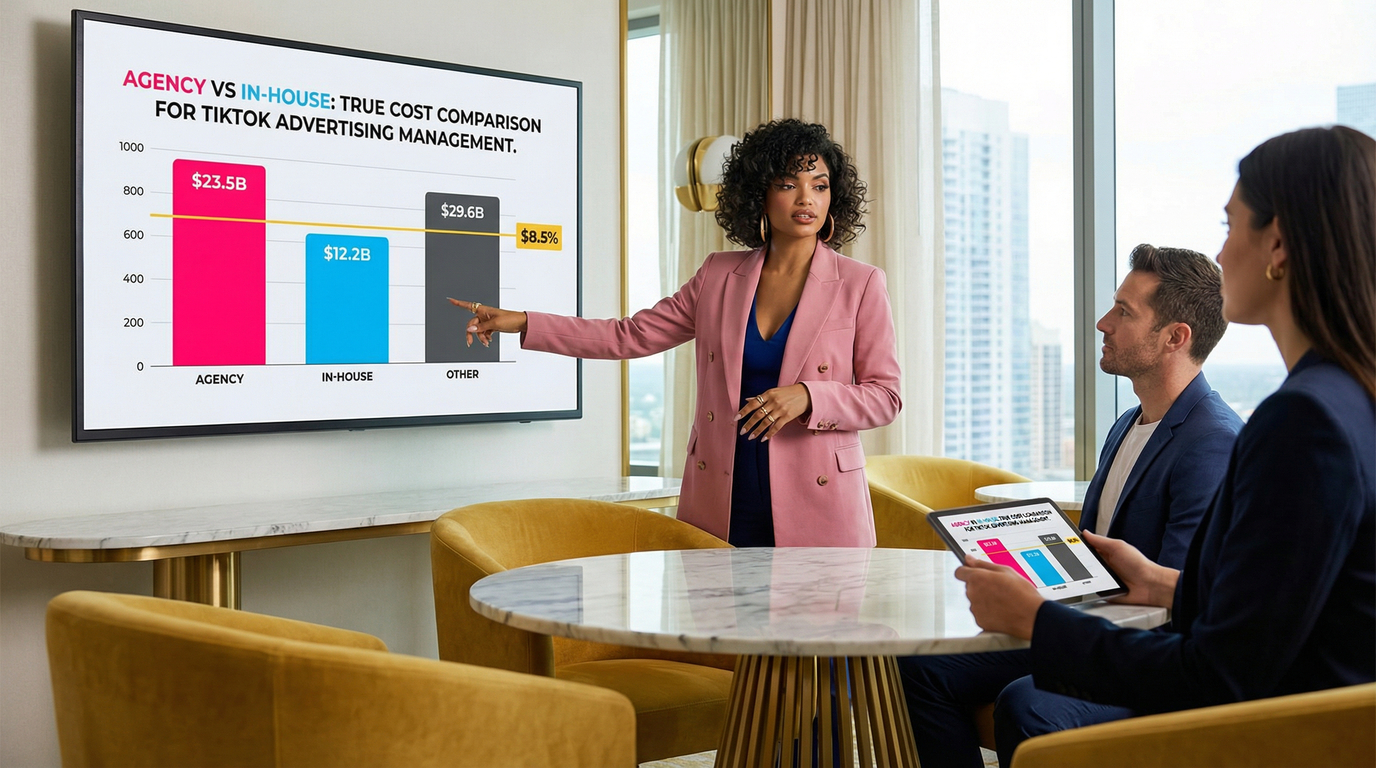
Most business owners dramatically underestimate the true cost of in-house TikTok management because they focus narrowly on salaries while overlooking dozens of additional expenses that accompany building internal teams. Beyond base compensation, you're funding benefits, payroll taxes, equipment, software, training, office space, management overhead, recruitment costs, and the opportunity cost of mistakes during learning curves. When you account for these complete costs, the financial comparison often looks quite different than initial assumptions suggest.
The calculus involves more than just money. Control, speed, specialization, scalability, and risk all factor into the optimal decision for your specific situation. Some businesses genuinely benefit from in-house management despite higher costs because strategic control and deep integration with business operations outweigh financial considerations.
Others waste resources building internal capabilities they'd acquire more efficiently through agency partnerships. Understanding which category you fall into requires honest assessment of your needs, capabilities, and constraints. This comprehensive guide breaks down the complete cost structures for both approaches, analyzes the non-financial factors that influence which model makes sense, identifies the breakeven points where in-house becomes more economical than agencies, and helps you determine which approach best serves your business based on your specific circumstances rather than generic rules that don't account for your unique situation.
Complete In-House Cost Breakdown
Building an effective in-house TikTok advertising team requires far more investment than just paying someone's salary, and most businesses underestimate these complete costs significantly.
Personnel costs begin with salaries but extend well beyond base compensation. A minimally viable TikTok team requires at least two to three people covering strategy and management, creative production, and media buying. A TikTok strategist or campaign manager with relevant experience commands sixty to ninety thousand dollars annually in most markets. Video content creator or editor positions pay fifty to seventy-five thousand dollars. Paid media specialists cost fifty-five to eighty-five thousand dollars. For three-person team, base salaries total one hundred sixty-five thousand to two hundred fifty thousand annually before any additional costs.
Employee benefits add thirty to forty percent of salary costs covering health insurance, retirement contributions, paid time off, sick leave, and other benefits. For our hypothetical team, benefits add approximately fifty to eighty thousand dollars annually. Payroll taxes including FICA, unemployment insurance, and workers compensation add another seven to nine percent of salaries, contributing thirteen to twenty-three thousand dollars annually. Suddenly your one hundred sixty-five thousand in salaries becomes two hundred thirty to three hundred fifty-three thousand in total personnel costs—thirty to forty percent higher than salary figures alone suggest.
Recruitment and onboarding represent significant upfront investments often overlooked in planning. Recruiting fees for experienced marketing roles typically run twenty to twenty-five percent of annual salary if you use outside recruiters. For three positions, recruitment could cost thirty-five to sixty thousand dollars. Even handling recruitment internally requires job board postings costing one to three thousand, substantial time investment from managers conducting interviews, background checks and screening at five hundred to fifteen hundred per hire, and relocation expenses if recruiting outside your market. Initial onboarding also includes reduced productivity during first ninety days representing thirty to fifty percent of salary as people ramp up, training costs for materials and programs, management time invested in onboarding, and platform certifications and education. Total recruitment and onboarding for three-person team easily reaches seventy-five to one hundred fifty thousand dollars.
Technology and software costs accumulate across multiple tools required for professional TikTok marketing. Video production software like Adobe Creative Cloud costs six hundred sixty annually per user, multiply by two creative team members equals thirteen hundred twenty dollars. Stock footage subscriptions, music licensing, and asset libraries cost twenty-four hundred to six thousand annually. Analytics and reporting platforms range from three thousand to twelve thousand yearly. Attribution and conversion tracking software adds six thousand to twenty-four thousand. Project management and collaboration tools cost twelve hundred to three thousand. Dashboard and visualization software adds another twelve hundred to forty-eight hundred. Total technology costs reach eighteen thousand to sixty thousand annually, and this assumes you're not buying premium enterprise versions of tools which cost significantly more.
Equipment and infrastructure required for quality video production includes professional cameras costing two to five thousand, lighting equipment at one to three thousand, audio equipment at five hundred to two thousand, tripods and stabilizers at five hundred to fifteen hundred, and backdrop and set materials at five hundred to two thousand. Initial equipment investment totals four thousand five hundred to thirteen thousand five hundred. Additionally, each team member needs high-performance computers costing twenty-five hundred to four thousand, plus monitors and peripherals at five hundred to one thousand each. Mobile devices for testing ads cost one to two thousand. Total equipment investment reaches fourteen thousand to twenty-five thousand initially, with annual replacement and upgrade cycles adding three to six thousand ongoing.
Office space costs vary dramatically by market but represent real overhead. If team members work from dedicated office space rather than general company space, allocate five hundred to fifteen hundred dollars per person monthly for workspace. This adds eighteen thousand to fifty-four thousand annually for three-person team. Even remote workers often receive home office stipends covering internet, furniture, and supplies adding two to five hundred monthly per person or seven thousand to eighteen thousand annually.
Ongoing education and professional development keeps team current as TikTok platform evolves rapidly. TikTok Marketing Certification programs cost five hundred to two thousand per person. Industry conferences and events run two to five thousand per person annually including registration, travel, and accommodation. Online courses and training programs add one to three thousand per person. Books, subscriptions, and resources cost five hundred to fifteen hundred per person. Total education costs reach twelve thousand to thirty-five thousand annually for three-person team, and this investment is essential rather than optional since platform changes constantly.
Hidden costs and inefficiencies significantly impact true total cost of ownership. Learning curve costs during first six to twelve months include suboptimal campaign performance during testing and mistakes, wasted ad spend from inexperienced optimization, missed opportunities from not knowing best practices, and platform policy violations and account issues. These learning costs conservatively reach twenty-five to seventy-five thousand in the first year. Management overhead includes HR administration time at five to fifteen thousand annually, performance reviews and development at three to eight thousand, conflict resolution and team dynamics management at two to ten thousand, and general oversight and coordination at five to fifteen thousand. Turnover and replacement costs matter because average marketing role tenure runs two to three years. Replacing a team member costs fifty to two hundred percent of annual salary when accounting for lost productivity, recruitment expenses, knowledge loss, and onboarding time for replacements. Spread across expected tenure, this adds twenty to sixty thousand annually to team costs.
Total first-year costs for building in-house three-person TikTok team therefore include personnel at two hundred thirty to three hundred fifty thousand, recruitment and onboarding at seventy-five to one hundred fifty thousand, technology and software at eighteen to sixty thousand, equipment initial investment at fourteen to twenty-five thousand, office space at eighteen to fifty-four thousand if applicable, education and training at twelve to thirty-five thousand, learning curve costs at twenty-five to seventy-five thousand, and management overhead at fifteen to forty-eight thousand. First year total reaches four hundred seven thousand to seven hundred ninety-seven thousand dollars.
Ongoing annual costs in years two and beyond include personnel at two hundred thirty to three hundred fifty thousand, technology and software at eighteen to sixty thousand, equipment replacement at three to six thousand, office space at eighteen to fifty-four thousand if applicable, education and training at twelve to thirty-five thousand, management overhead at fifteen to forty-eight thousand, and turnover costs at twenty to sixty thousand. Ongoing annual total reaches three hundred sixteen thousand to five hundred ninety-three thousand dollars.
These comprehensive cost breakdowns reveal why "just hiring someone to do TikTok" ends up costing far more than business owners initially expect. The complete economic picture requires accounting for all these elements rather than just focusing on salary numbers.
Complete Agency Cost Breakdown
Understanding agency pricing structure and total costs provides the comparison point for evaluating whether in-house or external management makes more financial sense.
Monthly retainer models represent most common agency pricing structure for small to medium businesses. Entry-level packages serving small businesses typically cost twenty-five hundred to five thousand monthly or thirty thousand to sixty thousand annually. These packages include basic strategy and planning, four to eight video ads monthly, campaign setup and management up to ten thousand monthly ad spend, and monthly reporting. Mid-market packages serving growing businesses cost five thousand to twelve thousand monthly or sixty thousand to one hundred forty-four thousand annually, providing comprehensive strategy and research, eight to sixteen video ads monthly, sophisticated targeting and optimization, biweekly reporting and strategy calls, and management of up to fifty thousand monthly ad spend. Enterprise packages serving large businesses cost twelve thousand to thirty thousand or more monthly or one hundred forty-four thousand to three hundred sixty thousand annually, including full-service comprehensive management, unlimited or near-unlimited creative production, daily optimization and monitoring, custom analytics and attribution, and unlimited ad spend management.
Percentage of spend models charge agencies based on advertising budget managed. Standard rates run fifteen to twenty-five percent of total ad spend. With ten thousand monthly ad spend at twenty percent, agency fee equals two thousand monthly or twenty-four thousand annually making total investment thirty-four thousand for management plus one hundred twenty thousand ad spend or one hundred fifty-four thousand total. At twenty thousand monthly ad spend, twenty percent fee equals four thousand monthly or forty-eight thousand annually for management plus two hundred forty thousand ad spend or two hundred eighty-eight thousand total.
Hybrid structures combine base retainers with percentage of spend. Example structure charges five thousand monthly base retainer covering strategy and core services plus fifteen percent of ad spend for media management. This model provides agencies guaranteed baseline revenue while still scaling compensation with client investment.
Project-based pricing for specific campaigns or launches typically costs fifteen thousand to seventy-five thousand depending on scope and duration. This works for defined initiatives rather than ongoing management.
Additional costs beyond base agency fees include setup and onboarding fees ranging from two thousand to ten thousand one-time covering initial strategy development, tracking implementation, and account setup. Some agencies waive these fees for longer commitments. Creative production beyond package inclusions costs fifteen hundred to five thousand per video for professional shoots, animation, or advanced production. Influencer partnership coordination if using this tactic costs one thousand to five thousand monthly plus influencer fees themselves. Specialized services like landing page optimization or email marketing integration typically cost extra if requested.
Total agency first-year costs therefore include monthly fees based on service level chosen, setup and onboarding fees at two thousand to ten thousand one-time, additional creative if needed at ten thousand to thirty thousand annually, and supplemental services if used at five thousand to twenty thousand. For mid-market package, first year totals seventy-seven thousand to two hundred fourteen thousand. For ongoing years, annual costs equal seventy thousand to two hundred four thousand.
These agency costs notably exclude the actual advertising spend on TikTok platform itself which you pay directly to TikTok. Agency fees cover management and services, while ad spend represents separate investment funding actual ad placement.
Direct Cost Comparison
Comparing total costs reveals when each model makes financial sense based on scale and objectives.
Three-year total cost of ownership provides realistic comparison since TikTok campaigns should run long enough to optimize and scale. In-house team over three years costs four hundred seven thousand to seven hundred ninety-seven thousand in year one, three hundred sixteen thousand to five hundred ninety-three thousand in year two, and three hundred sixteen thousand to five hundred ninety-three thousand in year three, totaling approximately one million thirty-nine thousand to one million nine hundred eighty-three thousand or average three hundred forty-six thousand to six hundred sixty-one thousand annually.
Mid-market agency over three years costs seventy-seven thousand to two hundred fourteen thousand in year one and seventy thousand to two hundred four thousand in years two and three, totaling two hundred seventeen thousand to six hundred twenty-two thousand or average seventy-two thousand to two hundred seven thousand annually. Agency delivers approximately two hundred seventy-four thousand to one million three hundred sixty-one thousand in savings over three years compared to in-house team, representing sixty to seventy percent lower costs.
Small business agency over three years costs forty-two thousand to ninety-five thousand in year one and thirty-six thousand to ninety thousand in years two and three, totaling one hundred fourteen thousand to two hundred seventy-five thousand or average thirty-eight thousand to ninety-two thousand annually. This represents approximately eighty to ninety percent savings versus in-house team.
The breakeven point where in-house becomes more economical occurs approximately when annual TikTok advertising spend exceeds one to one point five million dollars and campaigns are complex enough to truly require three or more full-time specialists. Below these thresholds, agencies typically provide superior cost efficiency.
Non-Financial Comparison Factors
Cost represents just one dimension of the agency versus in-house decision. Several qualitative factors significantly impact which model works best for your specific situation.
Expertise and knowledge access differs dramatically between models. Agencies provide immediate access to ten to fifty specialists across strategic planning, creative production, media buying, analytics, and account management. They bring cross-industry insights from working with dozens of clients. They maintain platform relationships and certifications including priority support access. They engage in continuous education without your investment. They provide diverse creative perspectives from varied team backgrounds. In-house teams offer deep brand and product knowledge from working exclusively on your business. They provide immediate availability and dedication. They align completely with company culture and values. They offer direct communication without agency intermediary. They build complete ownership of strategy and processes. They enable long-term knowledge retention without vendor dependencies.
Speed and efficiency considerations vary by scenario. Agencies deliver faster time to launch from established processes and existing expertise. They eliminate recruiting and onboarding delays of hiring employees. They provide proven methodologies avoiding trial-and-error learning. They can handle immediate campaign needs without staffing delays. In-house teams eventually achieve faster execution for routine tasks after initial learning curve. They provide immediate access without agency scheduling. They offer unlimited attention focused solely on your business. They enable rapid pivots without agency coordination.
Control and flexibility manifest differently. In-house teams give complete strategic control with no external dependencies. They allow immediate access and availability during business hours. They provide unlimited attention without competing client priorities. They offer no contract constraints limiting changes. They enable proprietary strategy ownership without sharing with agency. Agencies require shared control with external partner. They limit immediate availability to scheduled touchpoints. They split attention across multiple clients. They involve contract commitments and terms. They maintain strategy knowledge that leaves if relationship ends.
Scalability and flexibility differ substantially. Agencies enable seamless budget increases without new hiring. They provide access to additional specialists as needed. They offer flexible service levels matching business changes. They allow seasonal scaling without staffing complications. In-house scaling requires recruiting and onboarding additional team members over three to six months. It creates fixed costs regardless of campaign activity. It makes scaling down difficult without layoffs and severance. It provides less flexible capacity management overall.
Risk and liability profiles vary between approaches. Agency partnerships share performance risk with experienced specialists. They include contract protections and recourse options. They provide professional liability insurance coverage. They enable easier changes if performance disappoints. They avoid employment law complications from hiring and firing. In-house teams place complete performance risk on internal capabilities. They lack external recourse if team underperforms. They create employment obligations and regulations to navigate. They involve termination complexity and costs if changes needed. They concentrate knowledge loss if key team members leave.
Decision Framework and Recommendations
Determining which approach makes sense requires evaluating your specific situation against several key dimensions rather than applying generic rules.
Choose agency when annual TikTok budget falls below five hundred thousand to one million dollars. Testing TikTok viability before major commitment makes sense with agencies. You need immediate expertise without long hiring and onboarding timelines. You want to minimize financial risk through flexible relationships. You're managing multiple marketing channels requiring focus. You operate seasonally with variable campaign needs. Your organization lacks experience recruiting specialized marketing talent. You prefer capital efficiency over building internal capabilities.
Typical agency clients include small to mid-sized businesses, startups and growth-stage companies, companies with under fifty million annual revenue, businesses managing five or more marketing channels simultaneously, organizations prioritizing capital efficiency and flexibility, and companies without strong existing marketing infrastructure.
Choose in-house when annual TikTok budget exceeds one million dollars and platform represents primary customer acquisition channel. TikTok is core to business strategy requiring deep integration. You operate in highly specialized or regulated industry requiring proprietary expertise. You want complete strategic control without external dependencies. You possess strong internal marketing team infrastructure and management. You can attract and retain top marketing talent in your market. You're committed to platform long-term with stable investment. You need proprietary strategies providing competitive advantage. You require very high volume content production exceeding typical agency capacity.
Typical in-house profiles include large enterprises with substantial budgets, companies with over one hundred million annual revenue, brands where TikTok serves as primary customer acquisition, businesses with existing internal creative agencies or studios, organizations with established sophisticated marketing operations, and industries requiring deep specialized knowledge or compliance expertise.
Consider hybrid when annual budget reaches five hundred thousand to one million dollars and strategic importance warrants internal attention. Specific expertise exists internally that should be maintained. You want to build internal capabilities gradually while leveraging external support. Budget supports both internal and external resources comfortably. You desire control with expert execution support. Complex operations benefit from dedicated internal coordination.
Hybrid models combine in-house and agency strengths through various structures. In-house strategy with agency execution deploys one internal TikTok strategist at eighty-two thousand to one hundred twenty-four thousand plus agency creative and media buying at thirty-six thousand to seventy-two thousand monthly totaling one hundred eighteen thousand to one hundred ninety-six thousand annually. This maintains strategic control with expert execution. In-house creative with agency media buying uses one content creator at sixty-nine thousand to one hundred three thousand plus agency strategy and media buying at thirty-six thousand to seventy-two thousand monthly totaling one hundred five thousand to one hundred seventy-five thousand annually. This controls brand creative while leveraging media expertise. Agency foundation with internal oversight employs one marketing manager partly focused on TikTok plus full-service agency at sixty thousand to one hundred forty-four thousand annually totaling approximately one hundred ten thousand to one hundred ninety-four thousand. This ensures expert execution with internal coordination.
Making Your Decision
Several practical steps help you determine which approach best serves your specific situation and constraints.
Conduct honest capability assessment evaluating whether you can attract qualified talent in your market and pay competitive salaries. Consider if you possess management bandwidth to oversee TikTok team effectively. Assess whether you have infrastructure supporting marketing team operations. Evaluate your organization's track record building successful internal marketing capabilities. Determine if your company culture supports specialist team development. This honest assessment prevents optimistic assumptions about internal capabilities that don't match reality.
Calculate complete ROI scenarios comparing total costs and expected outcomes. Project three-year total investment for each approach including all costs identified earlier. Estimate realistic performance for each model considering learning curves, expertise differences, and execution quality. Calculate expected business outcomes like revenue, customers, or leads from each approach. Determine net profit or business value created after all costs. The model delivering superior net business value rather than lower cost wins this analysis.
Evaluate strategic fit asking which approach aligns with long-term business strategy and priorities. Consider how each model impacts speed to market and competitive positioning. Assess which creates more or less organizational complexity and dependencies. Determine which builds capabilities you want to own long-term. Evaluate which provides flexibility for future strategic changes. Strategic alignment often outweighs pure financial considerations for businesses with strong points of view about core capabilities.
Test and learn approaches minimize risk by starting smaller before full commitment. Begin with entry-level agency relationship for three to six months testing TikTok viability and performance potential. If results prove TikTok works well, then decide whether to scale with agency or transition in-house. Some businesses hire one internal person coordinating with agency, eventually building full team as volume justifies. Phased approaches reduce risk of wrong decisions based on incomplete information or untested assumptions.
Reassess periodically as businesses evolve and circumstances change. Strategy that makes sense at ten million in revenue with five thousand monthly TikTok spend might not make sense at fifty million revenue with fifty thousand monthly spend. Review the decision annually or when major business changes occur. Be willing to shift approaches as circumstances evolve rather than sticking with initial choice regardless of changed context.
The agency versus in-house decision profoundly impacts your TikTok advertising success and represents far more than simple cost comparison between monthly fees and employee salaries. Complete financial analysis accounting for all costs typically favors agencies for businesses spending less than one million annually on TikTok advertising while revealing in-house teams require much larger investment than initial salary estimates suggest. Beyond finances, considerations around expertise access, speed, control, scalability, and risk shape which model genuinely fits your needs. Most small to mid-sized businesses achieve better results and superior ROI through agency partnerships that provide immediate expertise, proven processes, and flexible relationships while reserving in-house development for organizations with sufficient scale, strategic importance, and organizational capability to justify the substantially higher investment and longer timeline that building internal capabilities requires.
More from the desk
FULL INDEX · 54 → Strategy & budgetInfluencer Marketing Agency vs In-House: Which Is Right for Your Brand?NO. 51 · 9 MIN
 Strategy & budgetInfluencer Marketing on a Small Budget: Getting Results with 1K–10K/MonthNO. 50 · 10 MIN
 Strategy & budgetHow to Vet Influencers: Spotting Fake Followers & Choosing the Right CreatorsNO. 49 · 9 MIN
LMG MEDIA · THE DESK
NO. 39 · FILED 01 DEC 2025 · LMG.MEDIA/BLOG
LMG.MEDIA/BLOG · © 2026
© 2026 LMG MEDIA
WHERE QUALITY BRANDS MEET ICONIC INFLUENCE