
Influencer Marketing Agency vs In-House: Which Is Right for Your Brand?
Deciding between an influencer marketing agency and building in-house? This complete guide covers the true costs, capabilities, and trade-offs of both approaches — helping brand marketers make the right decision for their specific situation.
LMG MEDIA TEAM
· 28 MAR 2026 · 9 MIN READ

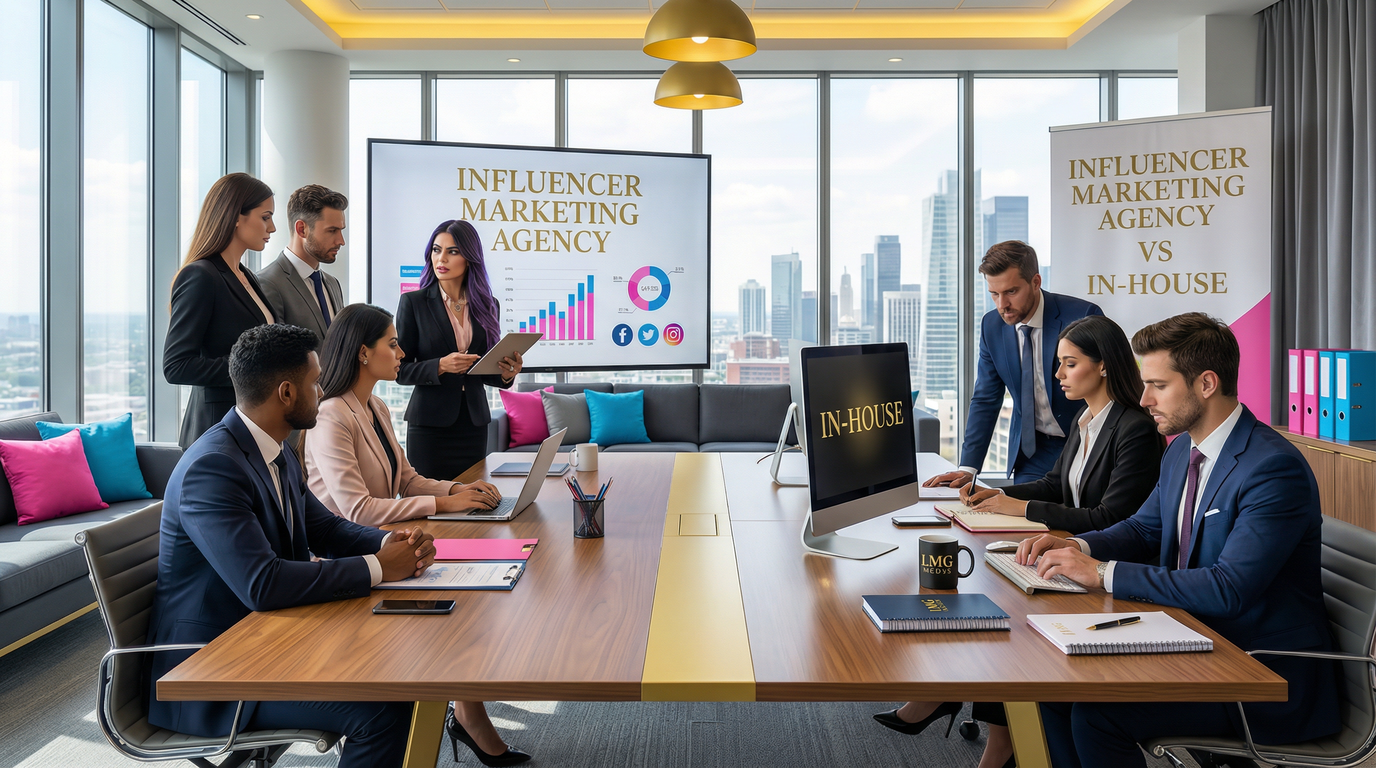
The question of whether to manage influencer marketing in-house or work with a specialist agency is one that most growing brands face at some point — and it is rarely as straightforward as it appears. The right answer depends on a combination of factors specific to each brand: budget, team capability, campaign complexity, market focus, and the strategic importance of influencer marketing within the overall marketing mix.
This guide provides an honest, comprehensive comparison of both approaches — covering the real costs, the genuine advantages and limitations of each, and a practical framework for deciding which model fits your brand's specific situation.
The Case for Working with an Agency
Creator Network and Relationships
The most significant advantage a specialist influencer marketing agency brings is an established creator network built through years of active campaign management. This is not a database of public social media accounts — it is a set of genuine working relationships with creators who know the agency, trust its reputation for being a good partner, and are willing to prioritise its briefs.
For brands without existing creator relationships, building this network from scratch takes 12 to 24 months of sustained effort and significant trial and error. An agency brings this network on day one — and the quality of creator partnerships it can access on a client's behalf reflects the reputation it has built across hundreds of campaigns.
Market Knowledge and Benchmarking
An active agency manages campaigns simultaneously across multiple clients, categories, and markets. This breadth of activity generates genuine market intelligence — current creator rate benchmarks, platform algorithm changes, emerging content formats, and category-specific performance data — that no single brand's in-house team can match.
For brands entering new markets or categories, this intelligence is particularly valuable. An agency that manages campaigns in Dubai, London, and New York simultaneously has current, first-hand knowledge of what is working in each market that would take an in-house team years to develop.
Operational Efficiency
Running influencer campaigns involves significant operational overhead — creator identification, outreach, negotiation, contracting, briefing, content review and approval, compliance management, tracking setup, reporting, and payment processing. For brands running multiple campaigns simultaneously across multiple platforms and markets, this operational load is substantial.
Specialist agencies have built operational infrastructure — processes, tools, templates, and team structure — specifically to manage this overhead efficiently at scale. An in-house team building this capability from scratch will spend the first year primarily on infrastructure rather than on campaign execution.
Compliance and Legal Expertise
Influencer marketing compliance — disclosure requirements, content claims, usage rights, exclusivity terms, and data protection — is increasingly complex, varies by market, and is actively enforced by regulators in key markets including the US, UK, EU, UAE, and Australia.
Agencies with active multi-market campaign experience have developed compliance expertise and contract templates that reflect current regulatory requirements across all relevant markets. For brands running campaigns across multiple jurisdictions, this expertise significantly reduces regulatory risk.
Scalability
Agency relationships scale more efficiently than in-house teams for brands whose influencer marketing activity fluctuates. A quiet quarter does not result in idle headcount costs; a major product launch does not require emergency hiring. The agency model provides flexible capacity that matches the brand's actual campaign requirements.
The Case for Building In-House
Deep Brand Knowledge
An in-house team develops a depth of brand knowledge — the product, the culture, the tone of voice, the competitive positioning, the internal approval dynamics — that an agency team working across multiple clients cannot replicate. This knowledge translates into better briefs, faster approvals, and content that feels more genuinely aligned with the brand's identity.
For brands with highly distinctive brand voices, complex products requiring deep technical knowledge, or internal approval processes that require constant navigation, an embedded in-house team consistently produces more brand-appropriate content than an external agency team.
Speed and Responsiveness
In-house teams can respond to real-time opportunities — trending moments, competitive reactions, timely cultural relevance — more quickly than agency relationships typically allow. For brands operating in fast-moving categories where real-time cultural relevance matters, in-house capability provides an agility that agency workflows cannot match.
Cost Efficiency at Scale
At sufficient volume, in-house influencer marketing can be more cost-efficient than agency fees. Brands spending £500,000 or more annually on influencer marketing — with a consistent, sustained programme across a defined set of markets and platforms — can often build equivalent capability in-house at lower total cost than agency retainers at that scale.
The key word is sufficient volume. At lower spend levels, the fixed costs of building an in-house team — salaries, tools, training, and time to reach proficiency — almost always exceed the equivalent agency investment.
Creator Relationship Ownership
When an agency manages creator relationships on a brand's behalf, those relationships belong to the agency rather than the brand. When agency relationships end, the creator network does not transfer. In-house teams build creator relationships that belong to the brand and that compound in value over time.
For brands committed to long-term ambassador programmes and sustained creator relationships, in-house management provides relationship ownership that agency models do not.
The True Cost Comparison
In-House Cost Components
Building a functional in-house influencer marketing capability requires:
Personnel — at minimum, one experienced influencer marketing manager ($70,000–$120,000 salary depending on market and seniority) plus time from creative, legal, and finance teams for brief development, contract review, and payment processing.
Technology — influencer discovery and analytics platforms ($500–$3,000 per month), contract management tools, tracking and attribution infrastructure, and content management systems.
Training and learning curve — 6 to 12 months for a new in-house team to build the market knowledge, creator relationships, and operational efficiency to match an established agency's capability. During this period, campaign results will typically be below what an experienced agency could deliver.
Total first-year cost — for a competent single-person in-house function: $120,000–$200,000 including salary, tools, and operational overhead.
Agency Cost Components
Agency cost structures vary significantly by model — retainer, project-based, or performance-based — and by agency scale and specialism.
Specialist agency retainers for ongoing campaign management typically range from $5,000 to $25,000 per month depending on campaign volume, market complexity, and scope of services.
Project-based fees for individual campaign management typically range from $5,000 to $50,000 per campaign depending on creator tier, number of creators, markets, and deliverables.
What is included — agency fees typically cover creator identification and vetting, outreach and negotiation, contract management, briefing, content review and approval, compliance management, tracking setup, and performance reporting. The value of this included operational overhead should be factored into any cost comparison with in-house alternatives.
The Break-Even Analysis
For most brands, the in-house model becomes cost-competitive with agency fees at approximately $300,000–$500,000 in annual influencer marketing spend — the level at which a dedicated in-house team's fixed costs are offset by the savings on agency fees. Below this level, the agency model is almost always more cost-efficient when the full cost of building in-house capability is properly accounted for.
The Hybrid Model
For many brands at mid-scale, the most effective approach is a hybrid — maintaining a small in-house team focused on brand knowledge, strategy, and key creator relationships, while using an agency for specific markets, campaign types, or capacity overflow.
This model captures the advantages of both approaches: the brand knowledge and relationship ownership of in-house, and the market expertise, creator network, and operational scale of agency.
Common hybrid structures include:
In-house strategy, agency execution — the in-house team develops campaign strategy, selects creators in consultation with the agency, and manages brand approvals, while the agency handles operational execution including outreach, contracts, tracking, and reporting.
In-house for domestic market, agency for international — the in-house team manages campaigns in the brand's primary domestic market where they have strong creator relationships, while an agency manages campaigns in international markets where local creator knowledge and relationships are required.
Agency for launch, in-house for sustain — using an agency to build the creator network, establish operational processes, and deliver the first major campaign phase, then transitioning ongoing management in-house once the infrastructure is in place.
Decision Framework: Which Model Is Right for Your Brand?
Use this framework to assess which approach fits your specific situation.
Choose an agency if:
- You are spending less than $300,000 annually on influencer marketing
- You are entering new markets where you have no existing creator relationships
- You need multi-market capability across different regulatory environments
- You do not have existing in-house influencer marketing expertise
- Campaign activity is seasonal or project-based rather than sustained year-round
- Speed to market is a priority and you cannot afford a 6–12 month capability-building period
Consider building in-house if:
- You are spending $500,000 or more annually on influencer marketing
- Your brand has a distinctive voice that requires deep brand immersion to execute well
- You are committed to long-term ambassador relationships and want to own those relationships
- Real-time cultural responsiveness is critical to your strategy
- You have or can hire experienced influencer marketing talent
Consider a hybrid model if:
- You have an established domestic programme but need international expansion
- You want to build in-house capability over time while maintaining campaign continuity
- Your campaign volume justifies some in-house resource but not a full team
Working with LMG Media
At LMG Media, we work with brands across the full spectrum — from those running their first influencer campaign to established programmes looking for market-specific expertise in London, New York, Dubai, Los Angeles, Miami, Paris, Madrid, Barcelona, Chicago, and Sydney.
Whether you are looking for full campaign management, market-specific support, or a hybrid arrangement that complements your existing in-house capability, we can structure a working model that fits your needs. Get in touch to discuss the right approach for your brand.
Summary
The agency versus in-house decision is not a binary choice between good and bad options — both models work well in the right circumstances. The key principles to carry forward:
- The agency model is almost always more cost-efficient below $300,000–$500,000 in annual spend when the full cost of building in-house capability is properly accounted for
- Agency relationships provide immediate access to creator networks and market knowledge that take years to build in-house
- In-house teams deliver deeper brand knowledge, faster response times, and creator relationship ownership that agencies cannot replicate
- The hybrid model captures the advantages of both — consider it seriously as an alternative to the binary choice
- The right model evolves as your programme grows — start with agency, build in-house selectively as scale justifies it
More from the desk
FULL INDEX · 54 → Strategy & budgetInfluencer Marketing on a Small Budget: Getting Results with 1K–10K/MonthNO. 50 · 10 MIN
 Strategy & budgetHow to Vet Influencers: Spotting Fake Followers & Choosing the Right CreatorsNO. 49 · 9 MIN
 Strategy & budgetMicro-Influencer Marketing Across Platforms: The Brand PlaybookNO. 48 · 9 MIN
LMG MEDIA · THE DESK
NO. 51 · FILED 28 MAR 2026 · LMG.MEDIA/BLOG
LMG.MEDIA/BLOG · © 2026
© 2026 LMG MEDIA
WHERE QUALITY BRANDS MEET ICONIC INFLUENCE