
Micro-Influencer Marketing Across Platforms: The Brand Playbook
Learn how brands build high-performing micro-influencer marketing programmes across Instagram, TikTok, and YouTube. This complete guide covers what micro-influencers are, why they outperform larger creators on key metrics, and how to run campaigns at scale.
LMG MEDIA TEAM
· 19 MAR 2026 · 9 MIN READ
The instinct to go bigger is deeply embedded in marketing. Bigger reach, bigger names, bigger impact. For decades, this logic drove media buying decisions — and for traditional broadcast advertising, it was largely correct.
In influencer marketing, it is frequently wrong.
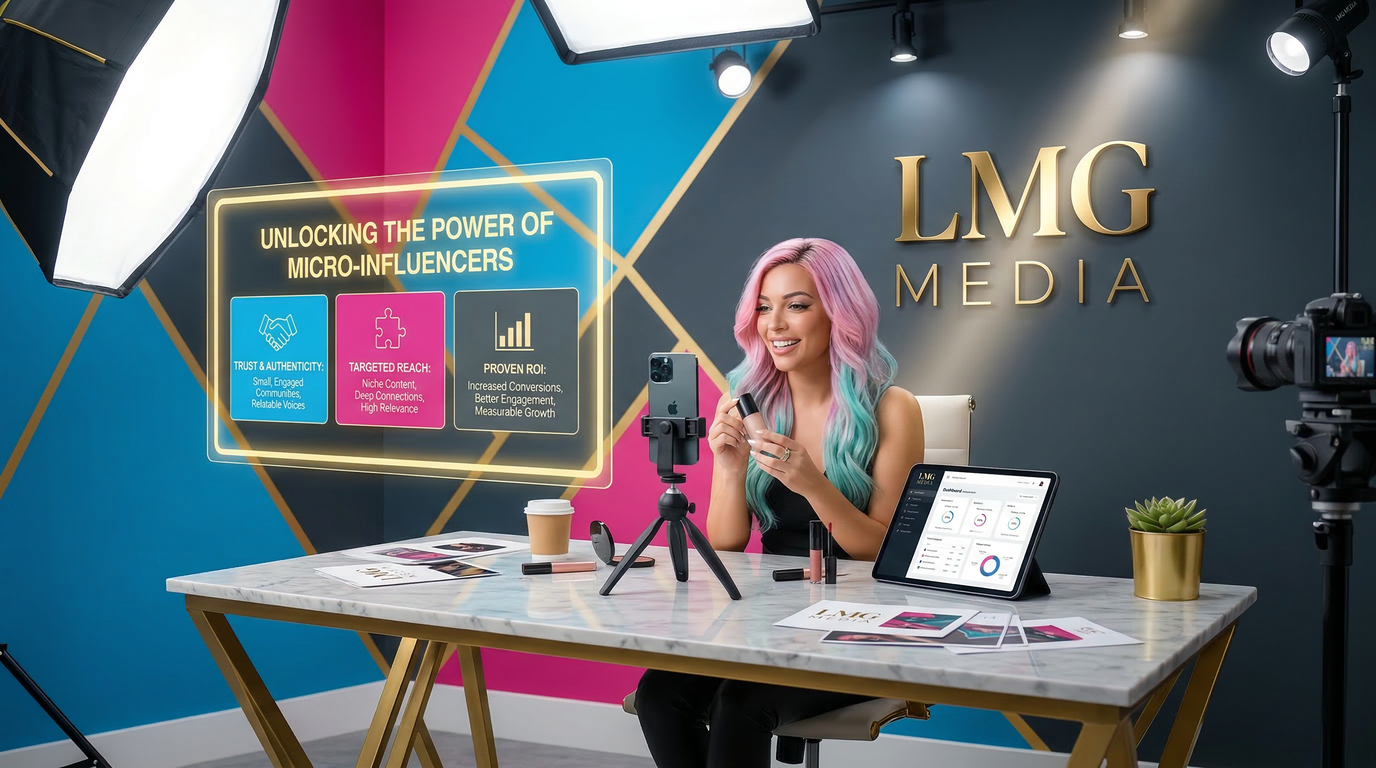
Micro-influencers — creators with between 5,000 and 100,000 followers — consistently outperform larger creators on the metrics that matter most for brand conversion: engagement rate, audience trust, purchase intent, and cost per acquisition. The brands that have figured this out are building micro-influencer programmes at scale and generating returns that mega-influencer campaigns cannot match.
This guide explains why micro-influencers perform, how to build a programme across platforms, and how to manage and measure campaigns at scale.
What Is a Micro-Influencer?
The industry defines micro-influencers as creators with follower counts typically between 5,000 and 100,000, though definitions vary. What matters more than the specific follower range is the combination of characteristics that defines micro-influencers as a category:
- A niche content focus — fitness, sustainable fashion, home cooking, book reviews, parenting, local lifestyle
- A highly engaged, loyal audience that follows them for specific expertise or personality
- A sense of genuine community between creator and audience
- Content that feels personal and authentic rather than produced or broadcast
These characteristics are the source of the micro-influencer's commercial advantage. They are not a consolation prize for brands that cannot afford larger creators — they are a genuinely distinct and frequently superior commercial proposition.

Why Micro-Influencers Outperform Larger Creators
Engagement Rate
The relationship between follower count and engagement rate is inverse: as creators grow larger, their engagement rates typically decline. A micro-influencer with 20,000 highly engaged followers might achieve engagement rates of five to ten percent. A mega-influencer with 5 million followers might achieve one to two percent. The micro-influencer's audience is more attentive, more responsive, and more likely to act on their recommendations.
Trust and Authenticity
Micro-influencers are perceived as more authentic and trustworthy than larger creators, for reasons that are intuitive once understood. A creator with 20,000 followers feels like a knowledgeable friend whose recommendations can be trusted. A creator with 5 million followers feels like a celebrity — admired, perhaps, but not trusted in the same personal way. The parasocial relationship between micro-creator and audience is closer and more intimate, and that intimacy directly translates into commercial influence.
Niche Relevance
Micro-influencers built their audiences by going deep on specific topics — they are not general lifestyle creators trying to appeal to everyone. This niche depth means that their audiences are highly self-selected consumers with strong interest in the creator's specific topic. A brand operating in that topic area is reaching an audience that has already opted into content about exactly what they sell.
Cost Efficiency
Micro-influencer fees are significantly lower than larger creator rates — but their commercial outcomes are often comparable or superior when measured on a cost-per-engagement or cost-per-acquisition basis. A programme of 50 micro-influencers can frequently generate more total conversions at a lower total cost than a single mega-influencer partnership, while also producing more content, reaching more diverse audiences, and building relationships with more creators.
Content Diversity
A micro-influencer programme naturally produces a wide variety of content — different aesthetics, different audiences, different geographic markets, different creative approaches. This diversity provides brands with a rich content library for repurposing across owned channels and paid media, and reduces the single-creator risk that comes with large investments in individual partnerships.
Micro-Influencer Marketing by Platform
Instagram is the most developed platform for micro-influencer marketing, with a mature ecosystem of creator tools, affiliate infrastructure, and brand partnership features. Instagram micro-influencers perform particularly well in fashion, beauty, food, home and interiors, wellness, and lifestyle categories. Key formats include Reels, carousel posts, and Stories.
The strongest Instagram micro-influencer programmes combine a mix of content formats — Reels for reach and discovery, carousels for educational and product-focused content, Stories for direct response and affiliate code sharing. Stories in particular convert strongly for micro-influencers because the more intimate, real-time format amplifies the sense of personal recommendation.
TikTok
TikTok's algorithm is uniquely favourable for micro-influencers. Unlike platforms where reach is directly proportional to follower count, TikTok distributes content based on engagement quality — meaning a micro-creator with 15,000 followers can reach millions of users with a single well-performing video. This organic reach potential makes TikTok micro-influencer programmes extraordinarily cost-efficient for brands willing to invest in creator relationships at scale.
TikTok Shop has further amplified the commercial value of micro-influencer partnerships on the platform. Small creators with highly engaged niche audiences can drive significant sales volume through TikTok Shop affiliate arrangements, and the platform's commission structure makes it accessible for brands of all sizes to build broad micro-creator networks.
YouTube
YouTube micro-influencer partnerships are particularly effective in categories where in-depth content drives purchase decisions — tech, gaming, fitness, beauty, and home improvement. A YouTube creator with 30,000 subscribers who produces detailed, well-researched reviews in a specific category will generate more genuine purchase intent than many larger creators whose content is less focused. YouTube micro-influencer content also has significant long-tail performance, continuing to drive traffic and conversions months after publication.
Building a Micro-Influencer Programme at Scale
Define Your Creator Profile
Before identifying specific creators, define the profile of the ideal micro-influencer for your brand. What niche or topic category? Which platforms? What geographic markets? What aesthetic sensibility? What follower range? What engagement rate threshold? A well-defined creator profile makes identification faster and selection more consistent.
Creator Identification
Finding the right micro-influencers requires more targeted research than simply browsing influencer platforms. The most effective approaches include searching platform-native hashtags and communities relevant to your niche, identifying creators who are already organically engaging with your brand or product category, reviewing the follower lists of existing brand partners and customers for hidden creator relationships, and using creator discovery tools with robust filtering capability.
Outreach and Onboarding
Micro-influencer outreach requires personalisation at a level that scales differently from large creator negotiations. For programmes of 20 to 50 creators, personalised outreach referencing the creator's specific content is feasible and advisable. For programmes of 100 or more creators, outreach templates that include personalised elements — a genuine reference to the creator's content and why it aligns with the brand — are more practical.
Onboarding materials should be clear, comprehensive, and easy to act on. Micro-influencers are often less experienced with formal brand partnerships than larger creators, and clear guidance on brief requirements, deliverables, disclosure obligations, payment process, and approval timelines reduces friction and improves content quality.
Brief for Authenticity
Micro-influencer briefs should lean heavily on creative freedom. The creator's authentic voice is their commercial asset — a prescriptive brief that scripts their content undermines the very quality that makes micro-influencer marketing effective. Provide clear brand context, mandatory inclusions, and parameters, then allow the creator to produce content that genuinely reflects their perspective and their audience relationship.
Affiliate and Tracking Infrastructure
Every micro-influencer in your programme should have a unique trackable link or discount code. This is not optional — without creator-level attribution data, you cannot optimise the programme, identify your best-performing creators, or accurately measure ROI. Set up affiliate tracking infrastructure before launching creator outreach.
Micro-Influencer Marketing Pricing
Micro-influencer rates are significantly more accessible than larger creator tiers:
Instagram:
- Nano creators (1K–5K followers): £50–£300 per post
- Micro creators (5K–50K followers): £150–£1,500 per post
- Upper-micro creators (50K–100K followers): £1,000–£3,000 per post
TikTok rates are typically 15 to 25 percent lower than Instagram equivalents. Affiliate-only arrangements — where creators receive product and commission rather than a flat fee — are common and effective at the lower end of the micro-influencer range.
For a full breakdown of influencer pricing across tiers and platforms, see our guide on [how much does influencer marketing cost].
Measuring Micro-Influencer Programme Performance
Micro-influencer programmes should be measured at both the individual creator level and the programme level.
Individual creator metrics: engagement rate, affiliate link clicks, discount code redemptions, and revenue generated per creator. This data allows continuous optimisation — scaling investment in the creators who perform and deprioritising those who do not.
Programme-level metrics: total reach, total engagement, total revenue attributed, overall cost per acquisition, and content volume generated. Compare programme-level metrics to equivalent investment in paid social or larger creator partnerships to evaluate the relative efficiency of the micro-influencer approach.
Content performance: track which pieces of micro-influencer content perform best organically and use the top performers as paid social creative for amplification. This compound approach — organic micro-influencer content boosted with paid media — consistently outperforms both channels in isolation.
Working with a Micro-Influencer Marketing Agency
At LMG Media, our micro-influencer marketing practice builds and manages creator programmes at scale — from initial creator identification and outreach through briefing, content approval, affiliate tracking, and performance reporting. We work across Instagram, TikTok, and YouTube in categories including fashion, beauty, fitness, ecommerce, and lifestyle. Get in touch to discuss building a micro-influencer programme for your brand.
Summary
Micro-influencer marketing is not a budget compromise — it is a strategically superior approach for many brand objectives, delivering higher engagement rates, stronger audience trust, better cost efficiency, and greater content diversity than equivalent investment in larger creator partnerships. The key principles to carry forward:
- Engagement quality and niche relevance matter more than follower count — a small, loyal audience in your category is more valuable than a large, diffuse one
- Build affiliate tracking infrastructure before launching the programme — creator-level attribution is essential for optimisation
- Brief for creative freedom — the creator's authentic voice is the asset
- Scale through diversity — 50 micro-influencers outperform one mega-influencer on most commercial metrics
- Amplify top-performing content with paid media for compounding return on the programme investment
More from the desk
FULL INDEX · 54 → Strategy & budgetInfluencer Marketing Agency vs In-House: Which Is Right for Your Brand?NO. 51 · 9 MIN
 Strategy & budgetInfluencer Marketing on a Small Budget: Getting Results with 1K–10K/MonthNO. 50 · 10 MIN
 Strategy & budgetHow to Vet Influencers: Spotting Fake Followers & Choosing the Right CreatorsNO. 49 · 9 MIN
LMG MEDIA · THE DESK
NO. 48 · FILED 19 MAR 2026 · LMG.MEDIA/BLOG
LMG.MEDIA/BLOG · © 2026
© 2026 LMG MEDIA
WHERE QUALITY BRANDS MEET ICONIC INFLUENCE