
How to Vet Influencers: Spotting Fake Followers & Choosing the Right Creators
Learn how to properly vet influencers before partnering with them. This complete guide covers how to identify fake followers, assess audience quality, evaluate content authenticity, and make confident creator selection decisions for your brand.
LMG MEDIA TEAM
· 19 MAR 2026 · 9 MIN READ
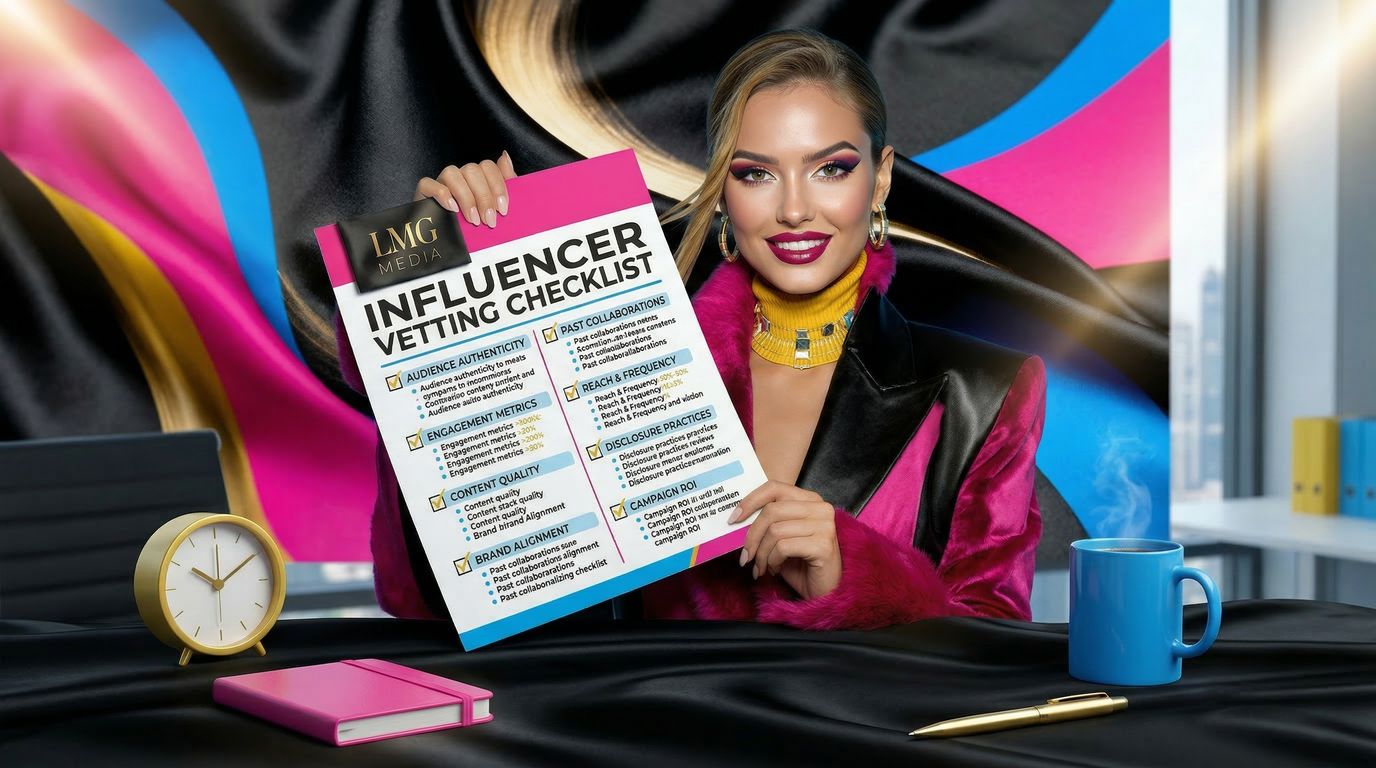
The influencer marketing industry has a fraud problem. Estimates suggest that a significant proportion of social media engagement is artificially generated — through purchased followers, engagement pods, bot activity, and other forms of audience inflation that make creators appear more influential than they actually are.
For brands investing in creator partnerships, the consequences of selecting a fraudulent or misrepresented creator are not just financial — a partnership that delivers no genuine reach or engagement is a wasted budget and a missed opportunity. A partnership with a creator whose audience is misaligned with your brand can actively damage results.
Vetting influencers properly — before any budget is committed — is one of the most important skills in influencer marketing. This guide covers exactly how to do it.
Why Influencer Fraud Exists and How It Works
Understanding the mechanisms of influencer fraud helps brands identify it more effectively.
Purchased followers are the most basic form of audience inflation. Services that sell social media followers exist openly, and a creator can acquire tens of thousands of followers for a relatively small sum. Purchased followers are typically inactive accounts, bots, or accounts from irrelevant geographies — they never engage with content and represent pure vanity metric inflation.
Engagement pods are groups of creators or accounts who agree to systematically like and comment on each other's content in order to inflate engagement metrics. Pod activity produces a specific pattern — rapid engagement immediately after posting, from the same group of accounts, often with generic comments — that can be identified with careful analysis.
Bot engagement involves automated account activity — likes, comments, and follows — generated programmatically rather than by real humans. Bot comments are typically generic, emoji-heavy, or contextually irrelevant to the content.
Audience geography manipulation occurs when creators use paid promotion or purchased engagement to attract followers from low-cost geographies — typically South and Southeast Asian markets — inflating follower counts and engagement numbers while producing an audience that has no relevance to the brand's target market.

Step 1: Assess Follower Count vs Engagement Rate
The first and most important vetting check is the relationship between a creator's follower count and their engagement rate.
Benchmark Engagement Rates by Platform and Tier
As a general guide, typical organic engagement rates by platform in 2026:
Instagram:
- Nano creators (under 10K): 5–10%
- Micro creators (10K–100K): 3–6%
- Mid-tier creators (100K–500K): 1.5–3%
- Large creators (500K–1M): 1–2%
- Mega creators (1M+): 0.5–1.5%
TikTok:
- Across tiers: 3–8% (TikTok tends to have higher engagement rates than Instagram at equivalent audience sizes)
YouTube:
- Engagement is measured differently; view-to-subscriber ratio of 20–50% is generally healthy
A creator whose engagement rate is significantly below these benchmarks — particularly if they have a large follower count — should be examined carefully. An account with 500,000 followers and 0.2% engagement is showing a pattern consistent with purchased followers or audience inflation.
Conversely, engagement rates dramatically above these benchmarks should also be investigated — they can indicate engagement pod activity.
Step 2: Analyse Engagement Quality
Engagement rate tells you how much engagement a creator receives. Engagement quality tells you whether that engagement is real.
What Genuine Engagement Looks Like
Real engagement on creator content is contextually relevant. Comments reference specific content in the post — they quote a line, ask a follow-up question, share a related personal experience, or respond to something specific the creator said or showed. Real commenters have active profiles with their own content, followers, and posting history.
What Fake or Pod Engagement Looks Like
Generic comments: "🔥🔥🔥", "Amazing!", "Love this!", "So beautiful!" — comments that could appear under any post from any creator. A comment section full of generic affirmations with no contextual relevance is a strong indicator of purchased or pod engagement.
Repetitive commenters: The same small group of accounts appearing in the comments of every post, particularly if those accounts have limited profile activity themselves.
Rapid comment velocity followed by silence: A post that receives 300 comments in the first 30 minutes and then none for the remaining day is showing a pattern consistent with pod activity.
Mismatched comment geography: Comments in languages or from geographies that do not match the creator's stated audience profile — for example, a UK lifestyle creator whose comment section is predominantly in Hindi or Portuguese.
Follower profiles with no content: Click through to a sample of the creator's followers. Accounts with no profile picture, no posts, and generic usernames are bot or purchased accounts.
Step 3: Check Audience Demographics
Every reputable creator should be able to provide audience demographic data from their platform analytics. For a paid partnership, this is a standard pre-commitment requirement — any creator who is unwilling to share basic audience data is a red flag in itself.
What to Verify
Geographic distribution. Does the creator's audience geography match your target market? A creator with 200,000 followers, 70% of whom are based in markets with no relevance to your brand, is delivering a fraction of the apparent reach.
Age and gender breakdown. Does the demographic profile align with your target consumer? This is particularly important in categories where demographic precision matters — beauty, finance, parenting, and fitness brands each need to verify that the creator's audience profile matches their target.
Sudden follower spikes. Review the creator's historical follower growth if available through third-party analytics tools. Gradual, consistent growth is healthy. A sudden spike of 50,000 followers in a single week, followed by flat growth, is a strong indicator of purchased followers.
Step 4: Review Content Consistency and Quality
Creator vetting is not just about fraud detection — it is also about creative and commercial fit. Review the creator's recent content — the last 60 to 90 days — with the following questions:
Is the content consistent? Creators who post sporadically, whose aesthetic shifts frequently, or whose content quality varies dramatically are higher-risk partners. Consistency indicates a professional approach and a stable audience relationship.
Is the branded content integrated naturally? Review any existing sponsored content the creator has produced. Does the sponsorship feel natural to their content and tone, or does the creator visibly switch into advertising mode? Creators who integrate brands authentically will do the same for your brand. Creators who produce clearly scripted, disconnected sponsored content will do the same.
How does sponsored content perform relative to organic content? If a creator's organic posts receive 50,000 engagements and their sponsored posts receive 3,000, their audience is actively disengaging with commercial content. This is a significant commercial risk you should be vetting.
Step 5: Check Brand Safety and Values Alignment
A creator's past content is the most reliable predictor of future brand safety. Review their content — including older content that may be less visible — for:
Content that conflicts with your brand values. Political statements, controversial opinions, or content that would create association problems for your brand.
Competitive brand partnerships. Has the creator recently partnered with a direct competitor? Do their existing brand partnerships create exclusivity conflicts or association issues?
Community behaviour. What is the culture of the creator's comments section and community? A creator whose community is characterised by hostility, discrimination, or toxicity represents a brand safety risk regardless of their follower count.
Step 6: Use Third-Party Analytics Tools
Third-party creator analytics platforms provide data that is not available from platform-native analytics alone. Key tools in the market include HypeAuditor, Modash, Upfluence, and Brandwatch — each offering varying combinations of follower authenticity scoring, engagement analysis, audience demographics, and historical growth tracking.
These tools are not infallible, but they provide a useful quantitative layer of analysis that complements the qualitative review process. An authenticity score — which estimates what percentage of a creator's followers are real, active accounts — is a particularly useful starting point for identifying creators who warrant further investigation.
Red Flags Summary
A quick reference checklist of the most common indicators of influencer fraud or poor creator fit:
- Engagement rate significantly below platform benchmarks for their follower tier
- Comment sections dominated by generic, contextually irrelevant comments
- Rapid engagement spikes immediately after posting, followed by silence
- Follower geography heavily concentrated in markets irrelevant to your brand
- Sudden follower growth spikes inconsistent with organic growth patterns
- Unwillingness to share audience demographic data
- Sponsored content performing dramatically worse than organic content
- Follower profiles with no content, no followers, and generic usernames
- Inconsistent posting frequency or significant recent changes in content aesthetic
Working with an Influencer Marketing Agency for Creator Vetting
Thorough creator vetting at scale requires both the right tools and the right expertise. An experienced influencer marketing agency brings existing relationships with verified creator partners, proprietary vetting processes, and access to analytics tools that provide authenticity data across creator databases.
At LMG Media, every creator partnership recommendation we make is backed by thorough vetting — covering engagement authenticity, audience demographics, content quality, and brand safety screening. We work across Instagram, TikTok, YouTube, and n categories including fashion, beauty, luxury, gaming, fitness, and ecommerce. Get in touch to discuss how we ensure every creator partnership delivers genuine results.
Summary
Influencer fraud is a real and significant risk in the creator economy — but it is a manageable one for brands that invest in proper vetting processes. The key steps to carry forward:
- Check engagement rate against platform benchmarks — significant deviation in either direction warrants investigation
- Analyse engagement quality, not just volume — real comments are contextual and specific
- Request and verify audience demographic data before committing any budget
- Review historical follower growth for artificial spike patterns
- Assess sponsored content performance relative to organic content
- Use third-party analytics tools for quantitative authenticity scoring alongside qualitative content review
More from the desk
FULL INDEX · 54 → Strategy & budgetInfluencer Marketing Agency vs In-House: Which Is Right for Your Brand?NO. 51 · 9 MIN
 Strategy & budgetInfluencer Marketing on a Small Budget: Getting Results with 1K–10K/MonthNO. 50 · 10 MIN
 Strategy & budgetMicro-Influencer Marketing Across Platforms: The Brand PlaybookNO. 48 · 9 MIN
LMG MEDIA · THE DESK
NO. 49 · FILED 19 MAR 2026 · LMG.MEDIA/BLOG
LMG.MEDIA/BLOG · © 2026
© 2026 LMG MEDIA
WHERE QUALITY BRANDS MEET ICONIC INFLUENCE