
Instagram Influencer Marketing Costs: Complete 2025 Pricing Breakdown
Understanding Instagram influencer pricing helps brands budget realistically and negotiate fair partnerships that deliver strong return on investment. Influencer rates vary dramatically based on follower count, engagement quality, content complexity, and dozens of other factors, but transparent pricing knowledge ensures you maximize value while compensating creators appropriately.
LMG MEDIA TEAM
· 29 NOV 2025 · 10 MIN READ
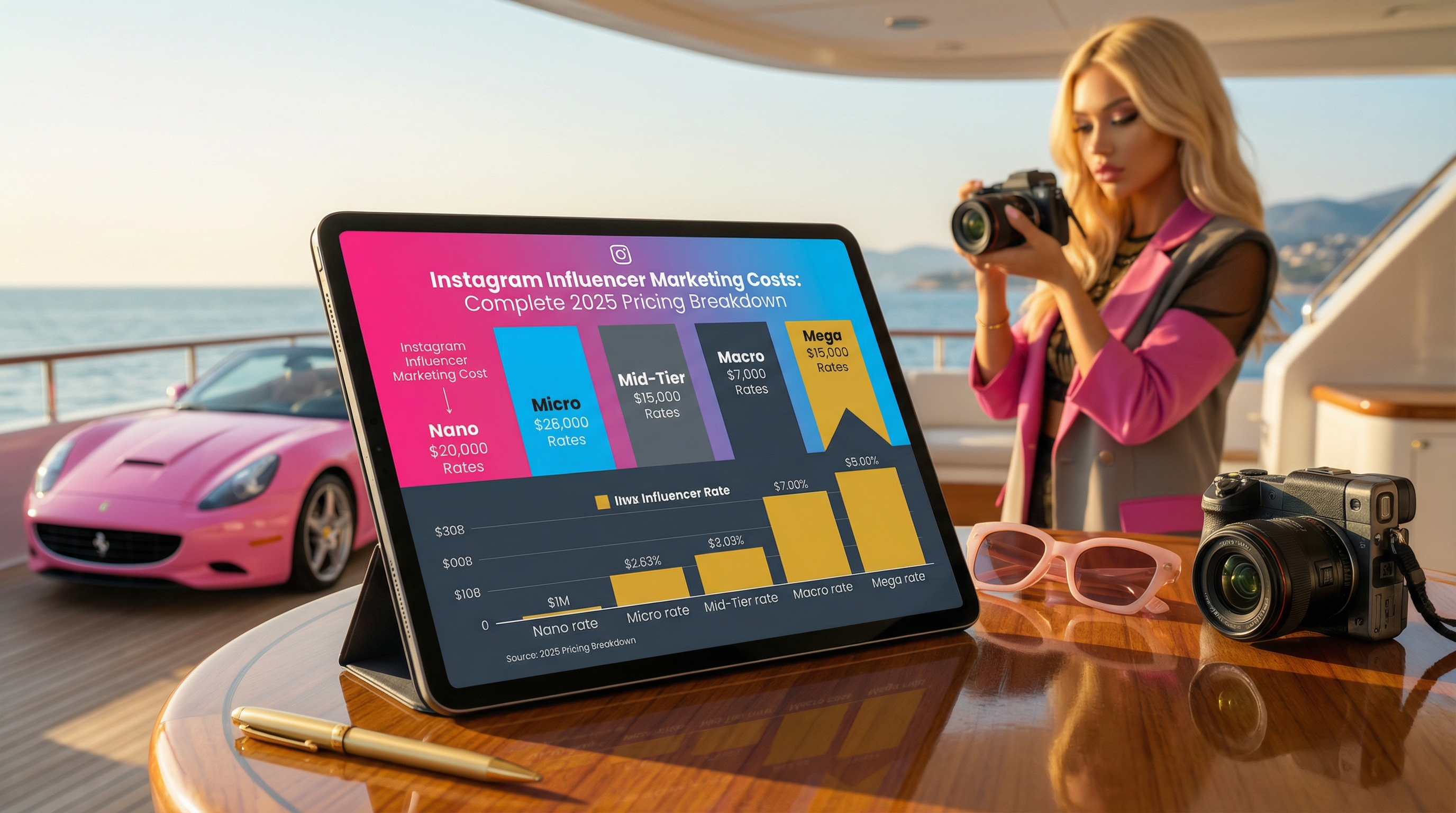
The Instagram creator economy has matured significantly, with standardized pricing tiers emerging across follower counts. However, smart brands look beyond simple rate cards to understand what truly drives value. An influencer with 50,000 highly engaged followers in your exact target demographic often delivers better results than one with 500,000 followers whose audience doesn't match your customer profile, even though the larger influencer costs five times more.
Instagram Influencer Pricing Tiers
Influencer pricing follows general patterns based on audience size, though individual rates vary significantly based on engagement quality, niche specialization, content production value, and negotiating dynamics.
Nano-Influencer Pricing: $10-$100 Per Post
Nano-influencers with 1,000-10,000 followers represent the most accessible entry point for brands exploring influencer marketing. These creators typically charge $10-$100 per post, though many accept product-only compensation, especially when products retail for $50-$200 and align closely with their content focus.
A nano-influencer with 5,000 followers might charge $50 for an Instagram feed post, $25 for a Story series, and $75 for a Reel. Some negotiate package deals offering multiple deliverables at discounted rates. A campaign including one feed post, five Story slides, and one Reel might cost $120-150 total rather than $150 if purchased separately.
Product exchange arrangements work well at this tier. A skincare brand might send $150 worth of products to a nano-influencer focused on clean beauty, requesting authentic review content in exchange. Many nano-influencers eagerly accept these arrangements because they're building portfolios and genuinely want to try products in their interest areas.
The value proposition with nano-influencers centers on authenticity and engagement rather than reach. These creators often know many followers personally and maintain engagement rates of 8-10%, far exceeding larger accounts. Their recommendations carry weight because followers view them as peers and friends rather than distant celebrities.
For brands, nano-influencers offer opportunities to test messaging, gather user-generated content, build grassroots advocacy, and achieve cost-effective awareness in niche communities. A $1,000 budget could support partnerships with 15-20 nano-influencers, creating substantial volume and diversification that single larger partnerships cannot provide.
Micro-Influencer Pricing: $100-$1,000 Per Post
Micro-influencers with 10,000-100,000 followers occupy the strategic sweet spot for most brand partnerships, balancing meaningful reach with strong engagement and reasonable pricing. Rates typically range from $100-$1,000 per post depending on follower count, engagement rate, content complexity, and usage rights.
A micro-influencer with 25,000 followers and 4% engagement might charge $300 for a single feed post, $150 for a Story series, and $450 for a Reel. The same content from a micro-influencer with 75,000 followers might cost $700, $300, and $1,000 respectively.
Content format significantly impacts pricing. Instagram Stories cost 40-60% of feed post rates due to their 24-hour lifespan versus permanent feed presence. Reels command 150-200% of feed post rates because of higher production requirements and algorithmic prioritization that delivers greater reach. Carousel posts typically cost 20-30% more than single images due to increased content creation effort.
Usage rights additions substantially increase costs. Basic partnerships include the influencer posting to their account and brands sharing to their own channels for 90 days, all covered by the base fee. Extended usage rights require additional payment:
- Paid advertising rights for 6 months: +50-100% of base fee
- Website and email usage for 1 year: +30-50% of base fee
- Cross-platform rights (TikTok, YouTube): +25-50% of base fee
- White-listing rights for 3 months: +40-60% of base fee
A micro-influencer charging $400 for a feed post might require $600 additional for 6-month paid advertising rights, bringing total investment to $1,000. While this seems expensive, the ability to run that high-performing authentic content as ads for six months often delivers far more value than the additional cost.
Exclusivity clauses also increase pricing. Preventing an influencer from working with direct competitors for 30-60 days before, during, and after a campaign typically adds 20-40% to base rates. Longer or broader exclusivity commands proportionally higher premiums.
Mid-Tier Influencer Pricing: $1,000-$5,000 Per Post
Mid-tier influencers with 100,000-500,000 followers have typically made content creation their primary income source and operate with increasing professionalism. Many work with management or agents who handle negotiation and contracting. Rates generally range from $1,000-$5,000 per post.
At this tier, influencers often present formal rate cards specifying:
- Feed post: $1,500-3,000
- Story series (5-10 slides): $750-1,500
- Reel (15-30 seconds): $2,000-4,000
- IGTV video (3-5 minutes): $2,500-5,000
These creators deliver consistently high production quality, understand brand partnership dynamics deeply, and provide reliable execution. Their larger audiences provide meaningful reach, though engagement rates typically decline to 2-4% as accounts grow.
Brands working at this tier should expect more structured processes including formal contracts, Net 30 or Net 60 payment terms, detailed content approval workflows, and comprehensive analytics reporting. Many mid-tier influencers require deposits before beginning work and maintain strict revision limits to prevent scope creep.
Campaign packages often provide better value than individual posts. A three-month partnership including six feed posts, twelve Story series, and four Reels might cost $25,000-35,000 as a package versus $40,000-50,000 if purchased individually. The influencer benefits from predictable income and the brand benefits from sustained visibility and relationship building.
Macro-Influencer Pricing: $5,000-$25,000 Per Post
Macro-influencers with 500,000-1,000,000 followers command premium rates reflecting their substantial reach and established personal brands. Pricing typically ranges from $5,000-$25,000 per post, with specific rates depending on engagement quality, audience demographics, and content deliverables.
These partnerships almost always involve agents or management companies handling negotiations. Brands should budget for longer sales cycles, more complex contracts, and higher production expectations. Macro-influencers may require creative approval, control over final content, and specific usage limitations.
A typical macro-influencer partnership might cost:
- Single feed post: $8,000-12,000
- Comprehensive campaign (3 posts, 6 Story series, 2 Reels): $35,000-60,000
- Quarterly ambassador program: $75,000-150,000
At this investment level, brands need strong attribution mechanisms to justify ROI. Unique promo codes, dedicated landing pages, and sophisticated analytics become essential. The value proposition shifts from direct response to brand building, credibility enhancement, and long-term awareness gains that benefit the business over quarters and years rather than immediately.
Celebrity and Mega-Influencer Pricing: $25,000-$500,000+ Per Post
Mega-influencers with over 1 million followers and celebrities command rates from $25,000 to $500,000+ per post depending on their fame, audience size, and brand alignment. These partnerships are primarily about awareness, prestige, and association rather than direct response and conversion.
A celebrity with 5 million followers might charge $100,000 for a single Instagram post, $50,000 for Stories, and $150,000 for a Reel. Comprehensive campaigns can easily reach $500,000-1,000,000+ in fees alone before adding production costs, usage rights, and appearance fees.
Celebrity partnerships require extensive legal review, detailed rights management, and often involve talent agencies, publicists, and multiple layers of approval. Brands should budget 6-12 months for negotiation and planning before content goes live.
The ROI calculation differs entirely at this level. Brands measure success through media impressions, press coverage, retailer interest, investor confidence, and overall brand elevation rather than direct sales attribution. A celebrity partnership that generates $1 million in equivalent advertising value through press mentions might justify a $200,000 fee even without a single directly attributed sale.
Factors Influencing Influencer Pricing
Beyond follower count, numerous factors affect what influencers charge and what brands should expect to pay for quality partnerships.
Engagement Rate Impact
Engagement rate dramatically influences value and should impact pricing negotiations. An influencer with 50,000 followers and 8% engagement (4,000 interactions per post) provides more value than one with 150,000 followers and 1.5% engagement (2,250 interactions per post), even though the second appears three times larger.
Calculate engagement rate by dividing total engagements (likes + comments + saves + shares) by reach or followers, then multiplying by 100. Industry benchmarks by tier:
- Nano (1K-10K): 8-10% engagement
- Micro (10K-100K): 3-6% engagement
- Mid-tier (100K-500K): 2-4% engagement
- Macro (500K-1M): 1.5-3% engagement
- Mega (1M+): 1-2% engagement
When evaluating influencer proposals, adjust pricing expectations based on engagement quality. An influencer with 4% engagement when their tier averages 2% should command premium rates. Conversely, one with 1% engagement when the tier averages 3% should charge below standard rates or improve their engagement before pursuing premium partnerships.
Niche and Industry Specialization
Certain industries command premium rates fro their Instagram campaigns due to audience value, content complexity, or market demand. Finance, B2B technology, luxury goods, and health/wellness influencers often charge 20-50% above base rates because their audiences have higher lifetime value or their content requires deeper expertise.
A finance influencer with 30,000 followers might charge $600 per post compared to $300 for a general lifestyle influencer with the same audience size. The finance influencer's audience likely has higher income, makes larger purchase decisions, and values expert guidance more highly, justifying the premium.
Similarly, highly technical niches like software development, legal services, or medical topics command premiums because the influencer brings specialized knowledge and credibility that general creators cannot provide.
Geographic Location
Influencer location affects pricing through cost of living differences and market maturity. US-based influencers typically charge 2-4x more than creators in developing markets with comparable follower counts and engagement.
A micro-influencer with 40,000 followers in Los Angeles might charge $500-700 per post, while a similar creator in Manila might charge $150-250 and one in Lagos $100-175. While the lower rates seem attractive, consider whether the audience demographics and geographic reach align with your target market. A US brand targeting American consumers likely achieves better results with US-based influencers whose followers match that profile, even at higher costs.
For global brands or those targeting specific international markets, partnering with in-market influencers often delivers better performance than working with larger creators in different regions, even if the in-market creators cost more per follower.
Content Production Quality
Production value influences pricing legitimately. An influencer who invests in professional photography equipment, lighting, editing software, and location scouting produces consistently higher quality content that reflects better on your brand and performs better algorithmically.
When comparing rates, evaluate content quality by reviewing the influencer's last 15-20 posts. Are photos consistently well-lit, properly composed, and professionally edited? Do videos have smooth transitions, clear audio, and engaging pacing? Does the feed maintain a cohesive aesthetic?
Premium content creators often charge 30-50% above base rates but deliver content you can repurpose across marketing channels, providing additional value that justifies higher fees. A beautifully shot product photo from a high-quality influencer might be used on your website, in email campaigns, and as paid ad creative, multiplying its value beyond the original post.
Seasonality and Demand
Influencer rates fluctuate based on seasonal demand. November and December command premium rates as brands compete for holiday campaign slots. Summer months for travel and fashion brands, back-to-school period for family and education brands, and January for fitness and wellness brands all see increased demand and higher pricing.
During peak seasons, expect rates 20-40% above normal. Booking campaigns 2-3 months in advance during off-peak periods often yields better rates and preferred scheduling. An influencer who charges $500 per post in July might ask $650 in November simply due to higher demand for their limited capacity.
Frequently Asked Questions
How much should I budget for influencer marketing as a small business?
Small businesses can start testing influencer marketing with $1,000-2,000 monthly budgets, allowing partnerships with 5-10 nano and micro-influencers. This provides enough scale to gather meaningful data while keeping financial risk manageable. As you prove ROI, scale to $3,000-5,000 monthly for more comprehensive programs. Remember that budgets include not just influencer payments but also product costs, basic tracking tools, and time investment. Starting below $500 monthly rarely generates sufficient impact to evaluate effectiveness properly.
Do influencer rates include usage rights for ads?
No, standard influencer rates typically cover only the original post to their account and basic brand sharing to your own channels for 60-90 days. Using content in paid advertising requires explicit additional compensation, usually 50-100% of the base fee for 6-12 month rights. Always clarify usage rights in contracts before content creation. Attempting to use influencer content in ads without permission violates copyright law and damages relationships. Budget for extended rights upfront when planning campaigns that will include paid amplification.
Should I pay influencers per post or per campaign?
Per-campaign pricing typically provides better value for brands and predictability for influencers. A campaign package including multiple deliverables usually costs 15-25% less than purchasing posts individually and ensures cohesive storytelling across touchpoints. For first-time partnerships, starting with per-post arrangements reduces risk while testing fit. Once you identify strong partners, transition to campaign or retainer-based relationships for efficiency and savings.
More from the desk
FULL INDEX · 54 → Strategy & budgetInfluencer Marketing Agency vs In-House: Which Is Right for Your Brand?NO. 51 · 9 MIN
 Strategy & budgetInfluencer Marketing on a Small Budget: Getting Results with 1K–10K/MonthNO. 50 · 10 MIN
 Strategy & budgetHow to Vet Influencers: Spotting Fake Followers & Choosing the Right CreatorsNO. 49 · 9 MIN
LMG MEDIA · THE DESK
NO. 38 · FILED 29 NOV 2025 · LMG.MEDIA/BLOG
LMG.MEDIA/BLOG · © 2026
© 2026 LMG MEDIA
WHERE QUALITY BRANDS MEET ICONIC INFLUENCE