
Stop Undercharging: The Real Way to Calculate Your Influencer Rate in 2026
That brand offer of $500 for three Reels? You just left $2,700 on the table. Stop using simple follower calculators that undervalue your work. Learn how to calculate your actual worth based on engaged audience, content type, usage rights, and exclusivity—the same way professional agencies do.
LMG MEDIA TEAM
· 24 JAN 2026 · 11 MIN READ
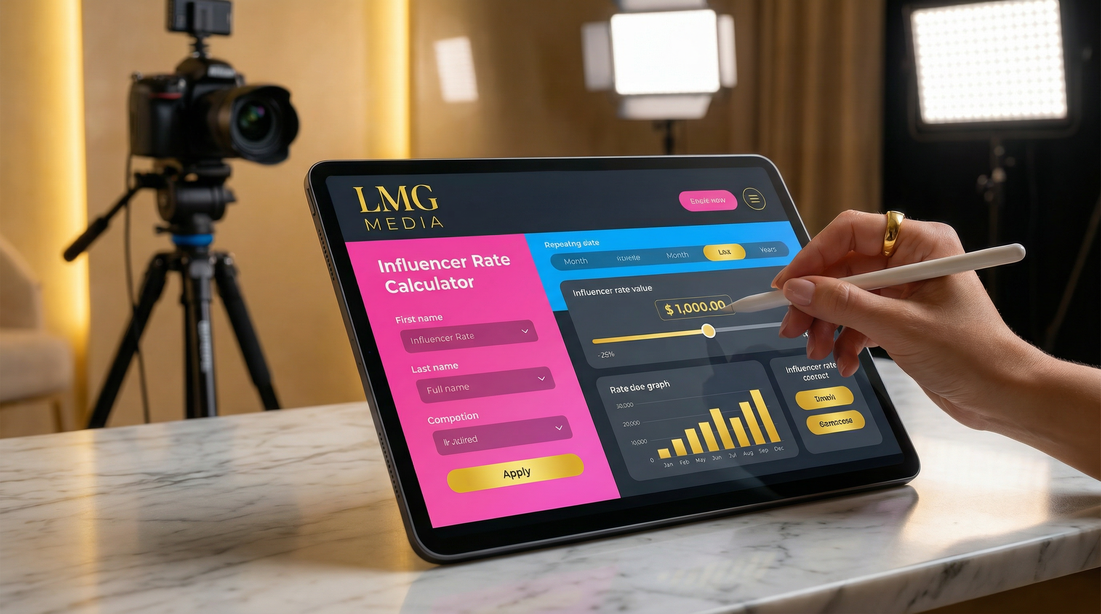
The $2,700 Mistake
A brand slides into your DMs with an opportunity. They want three Instagram Reels for an upcoming campaign. They offer $500. You're excited about the collaboration, so you say yes immediately. You've just made a critical error that cost you $2,700.
That campaign should have paid at least $3,200 based on industry standards and your actual value. But you had no framework for knowing that, so you accepted what seemed like a generous offer. This scenario plays out thousands of times every single day because nobody actually teaches creators how to price their work properly.
Why Simple Calculators Fail You
Search for "influencer rate calculator" on Google and you'll find the same oversimplified formula repeated across dozens of websites. Take your follower count and multiply it by one cent. So if you have 50,000 followers, you should charge $500 per post, right? This calculation is not just incomplete, it's actively costing you money.
This simplistic formula completely ignores the metrics that actually matter. It doesn't account for your engagement rate, which is the most important metric brands look at when evaluating creators. It treats all content types the same, even though creating a Reel requires far more work than posting a Story. It doesn't factor in usage rights, treating organic posts and paid advertising licenses as equivalent. It ignores exclusivity requirements that limit your ability to work with other brands. And it completely overlooks niche differences, even though finance creators command premium rates compared to general entertainment content.
Consider two creators, both with 50,000 followers. One has a 5% engagement rate while the other has 1% engagement. The first creator should be charging three to four times more than the second, but most online calculators would tell them to charge exactly the same amount. This is why you're likely undercharging for every single collaboration.
What Brands Actually Pay For
Here's the fundamental truth that most creators miss: brands don't pay for your follower count. They pay for engaged audience reach. Your follower number is just a vanity metric. What matters is how many of those followers actually interact with your content.
Let's compare two hypothetical creators. Creator A has 100,000 followers with a 1% engagement rate, giving them 1,000 engaged followers. Creator B has 50,000 followers with a 4% engagement rate, giving them 2,000 engaged followers. Creator B has double the engaged audience despite having half the total followers. So who should charge more? Creator B, obviously. But if you're using a simple follower-based calculator, you'd charge half as much as Creator A even though you deliver twice the value.
This disconnect between follower count and actual value is precisely why you're undercharging for your work.
The Real Formula That Agencies Use
Professional influencer agencies don't use simple follower counts when calculating rates. They use a more sophisticated formula that accounts for actual engagement and various multipliers. Here's how it works in practice.
Start by calculating your engaged audience. Take your follower count and multiply it by your engagement rate. If you have 50,000 followers and a 4% engagement rate, you have 2,000 engaged followers. This is your real reach.
Next, apply your tier rate based on your follower count and engagement level. Micro-influencers with 10,000 to 50,000 followers typically command $10 to $15 per 1,000 engaged followers. Mid-micro creators with 50,000 to 100,000 followers can charge $12 to $18 per 1,000 engaged. Mid-tier influencers with 100,000 to 500,000 followers should be charging $15 to $25 per 1,000 engaged.
Then you apply multipliers based on the specific requirements of the deal. Content type makes a huge difference. An Instagram post gets a 1.0x multiplier as the baseline. An Instagram Reel, which requires more production effort and typically performs better, gets a 1.5x multiplier. Instagram Stories, which are ephemeral and require less production, get a 0.3x multiplier. TikTok videos typically use the 1.0x baseline, while YouTube integrations command a 3x to 5x multiplier due to the production requirements and longer content lifespan.
Usage rights dramatically impact your pricing. If the brand wants to use your content for organic posts for 30 days, that's your base rate. Extending usage to 90 days of organic content should add 20% to your fee. If they want to run paid advertisements with your content for 30 days, that's a 50% premium. Paid ads for 90 days should double your base rate. And if they want perpetual rights to use your content forever, that should triple your base rate at minimum.
Exclusivity requirements also command premiums because they limit your ability to earn money from competitors. A 30-day exclusivity period should add 15% to your rate. Sixty days of exclusivity should add 30%. Anything beyond 90 days should add at least 50%, and honestly, you should think carefully about whether any amount of money is worth being blocked from an entire category for that long.
Let's walk through a real example to see how this works. Imagine you have 50,000 followers with a 4% engagement rate. A brand wants three Reels with 90-day organic usage rights and 30-day exclusivity. Here's how you'd calculate your fair rate.
Your base rate is calculated by dividing your followers by 1,000 and multiplying by your tier rate. So that's 50 times $15, which equals $750 per post. Since these are Reels, you multiply by 1.5, bringing you to $1,125 per Reel. For three Reels, that's $3,375. The 90-day usage rights add 20%, bringing you to $4,050. The 30-day exclusivity adds another 15%, putting you at $4,658. You might offer a small bundle discount, say 10%, which brings the final number to $4,192.
Your fair rate for this campaign is somewhere between $3,800 and $4,500. That's eight to nine times more than the $500 you were about to accept. This is the difference between guessing and actually knowing your value.
Current Market Rates for 2026
Let's get specific about what creators at different levels should be charging in today's market. These are baseline rates for organic content with standard 30-day usage. You'll add premiums for extended usage, paid ads, and exclusivity.
If you're a micro-influencer with 10,000 to 50,000 followers and maintaining a healthy 3% to 5% engagement rate, you should be charging $300 to $700 for an Instagram post. Instagram Reels should command $450 to $1,050. A package of three Reels should be priced between $1,200 and $2,800. Yes, these numbers are probably higher than what you've been charging. That's the point.
Mid-micro creators with 50,000 to 100,000 followers and similar engagement rates should charge $700 to $1,400 for posts, $1,050 to $2,100 for Reels, and $2,800 to $5,600 for three-Reel packages.
Mid-tier influencers with 100,000 to 500,000 followers should be commanding $1,500 to $4,000 per post, $2,250 to $6,000 per Reel, and $6,000 to $16,000 for three-Reel packages.
Remember, these are starting points for organic content. Every additional requirement should increase these numbers. Paid advertising rights, extended usage periods, and exclusivity clauses should all command significant premiums on top of these baseline rates.
Red Flags That You're Being Lowballed
Certain patterns in brand offers should immediately raise red flags that you're being undervalued. If a brand is offering you less than $8 to $10 per 1,000 engaged followers, they're lowballing you compared to industry standards. If they want perpetual usage rights at your base rate when industry standard is at least triple for perpetual licenses, walk away. If they're asking for an excessive number of deliverables relative to the payment, like offering $1,500 for ten posts which works out to just $150 each, they're trying to get volume pricing that doesn't serve your interests.
Watch out for brands that refuse to negotiate at all, responding to your counteroffer with "take it or leave it." Professional brands understand that pricing is negotiable. And be extremely wary of vague payment terms like "we'll pay after the campaign ends." Without specific payment deadlines and terms, you have no protection.
How to Actually Negotiate Your Rate
Negotiating rates is a skill that improves with practice, but there are proven approaches that work consistently. The first rule is simple: never accept the first offer. When a brand offers you $2,000, respond with something like: "Thank you so much for thinking of me! Based on my engagement rate and the scope of this campaign, my rate for this project is $3,200. I'd be happy to discuss this if that works within your budget."
You should always anchor high in negotiations. If you want to end up at $3,000, start by asking for $3,500. This gives you room to negotiate down while still hitting your target number. Brands expect some back and forth, and starting higher than your minimum gives you negotiating flexibility.
When you present your rate, always ground it in data rather than feelings. Don't say "I feel like I deserve more" or "I think I'm worth more than that." Instead, say something like: "Based on industry standards of $15 per 1,000 engaged followers and my consistent 4.2% engagement rate, the fair market rate for this scope is $3,200." You're not making an emotional appeal, you're citing objective market data.
You must be genuinely willing to walk away from offers that don't meet your minimum rate. Try saying: "I really appreciate the opportunity and would love to work with your brand. However, I can't accept less than $2,500 for this scope of work. If your budget allows for that, I'd be excited to move forward together." This shows respect for their budget constraints while holding firm on your value.
When a brand's budget is genuinely limited, negotiate the scope rather than your rate. Don't agree to create three Reels for $1,500, which works out to just $500 each. Instead, say: "At $1,500, I can create one Reel and three Stories for you." This preserves your per-deliverable rate while still giving the brand content they can use. You're being flexible about what you'll create, but not about what your work is worth.
The Mindset Shift That Changes Everything
Most creators approach brand deals with the mindset of "I'm so lucky they want to work with me." This is exactly backwards, and it's costing you thousands of dollars per campaign. You need to flip this perspective entirely.
Start thinking: "They're lucky I'm considering working with them." This isn't arrogance. It's recognizing the real value you bring to the table. You have an engaged audience that genuinely trusts your recommendations. You have creative skills that allow you to produce professional content. You have a platform that you built from scratch through consistent effort. You have influence that directly drives purchasing decisions and sales. All of this is genuinely valuable, and you should price it accordingly.
What Happens When You Charge Fair Rates
Let's look at the practical difference between undercharging and fair pricing over the course of a few months. With the old approach of accepting lowball offers, you might do ten campaigns at $500 each, earning $5,000 total. You're exhausted from juggling ten different brand relationships, ten sets of revisions, ten contracts, ten approval processes. It's barely sustainable.
With the new approach of charging fair market rates, you do three campaigns at $3,000 each, earning $9,000 total. You've nearly doubled your income while reducing your workload by 70%. You have time to create better content. You can be more selective about which brands you work with. You can focus on partnerships that genuinely align with your audience rather than taking everything that comes your way. More money, less work, better brands, and more sustainable business practices.
Calculate Your Rate Properly
The difference between guessing at your worth and calculating it properly can literally be thousands of dollars per campaign. You need a framework that accounts for all the variables: your engaged audience rather than just followers, the specific content type and platform, usage rights and duration, exclusivity requirements, and niche-specific premiums that apply to your category.
A proper rate calculator should show you your fair rate range based on current market standards, tell you what number to start negotiations at so you have room to negotiate down, identify your absolute minimum so you know when to walk away, flag red flags in brand offers so you can spot lowball attempts, and show you how you compare to industry averages so you can contextualize your pricing.
Stop guessing what you're worth. Stop accepting the first number a brand throws at you. Stop leaving thousands of dollars on the table with every campaign. Calculate your actual value and charge accordingly.
[Calculate My Fair Rate →]
More from the desk
FULL INDEX · 54 → Strategy & budgetInfluencer Marketing Agency vs In-House: Which Is Right for Your Brand?NO. 51 · 9 MIN
 Strategy & budgetInfluencer Marketing on a Small Budget: Getting Results with 1K–10K/MonthNO. 50 · 10 MIN
 Strategy & budgetHow to Vet Influencers: Spotting Fake Followers & Choosing the Right CreatorsNO. 49 · 9 MIN
LMG MEDIA · THE DESK
NO. 46 · FILED 24 JAN 2026 · LMG.MEDIA/BLOG
LMG.MEDIA/BLOG · © 2026
© 2026 LMG MEDIA
WHERE QUALITY BRANDS MEET ICONIC INFLUENCE